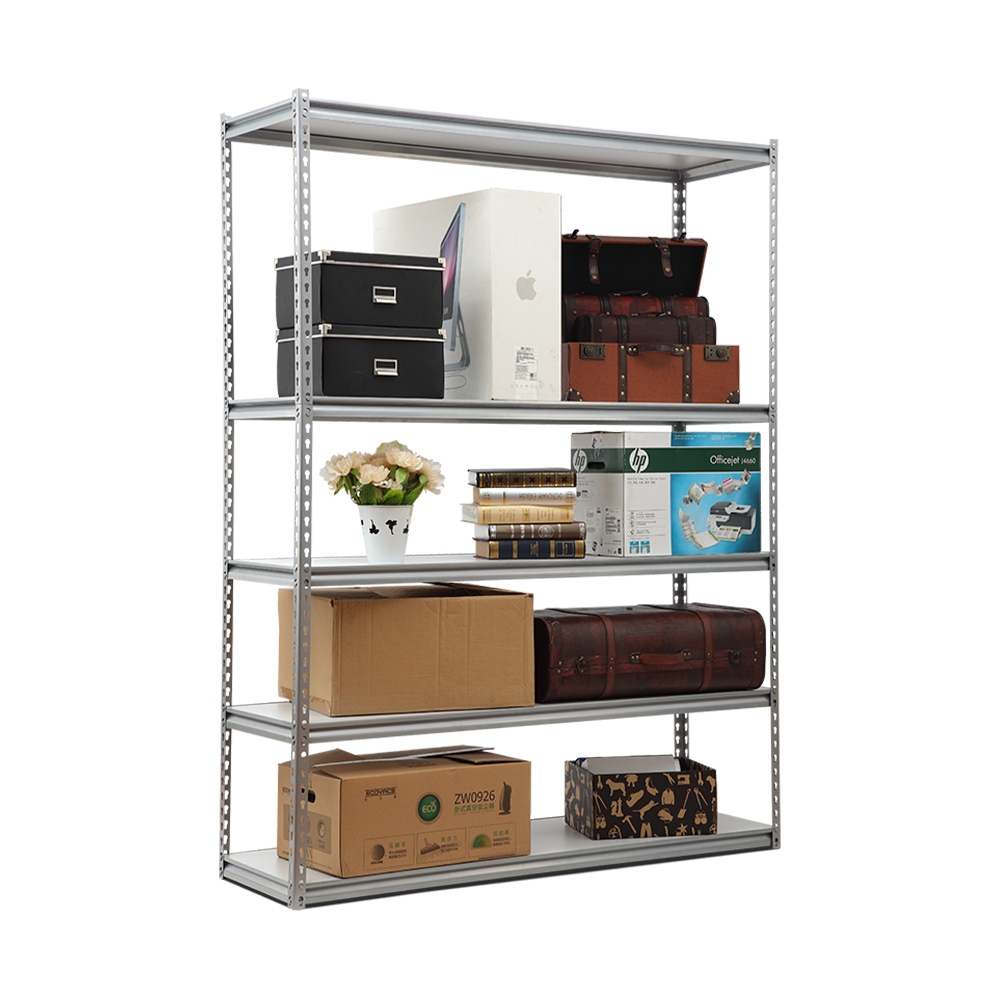
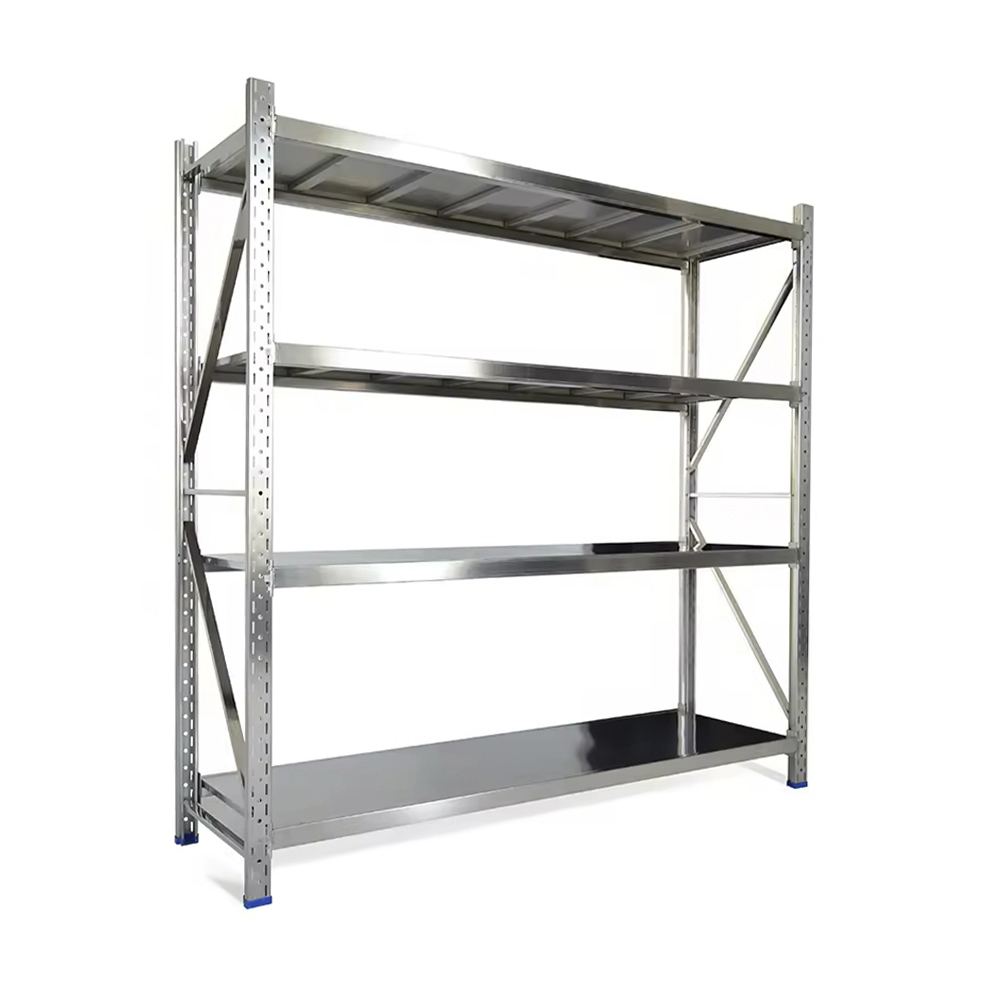
Nobody plans a warehouse, a shop fit-out or a stockroom around the bracket. It is the small, folded, painted piece of steel that sits under the shelf board and only gets noticed when the shelf starts to dip, the front edge drops out of level, or a fixing pulls loose from the wall. Yet on most shelving systems, metal brackets for shelves carry the entire load path between the board and the upright or wall behind it, and one steel gauge or two millimetres of hole pitch is often the difference between a run of shelving that holds up for a decade and one that needs re-tightening every quarter.
Here is the short version before the detail. A shelf bracket is defined by three numbers that have to agree with each other: the steel gauge that sets its stiffness, the fixing pattern that decides whether it fits the upright or wall you already have, and the coating that decides how long it survives in a humid, dusty or temperature-swinging room. When those three line up, almost nothing else about a shelving project causes trouble. When one of them is off, the symptom usually shows up somewhere else, as a sagging board, a cracked weld, an elongated screw hole, or a reorder that will not fit the frames already standing on site.
This guide is written for the people who buy brackets in volume and have to live with the consequences: warehouse and maintenance managers replacing damaged parts, retail fit-out teams rolling out store shelving, and importers, wholesalers and brand owners sourcing shelf brackets from Asia. It covers how load actually travels through a bracket, how to read gauge and load ratings, how to measure a bracket before reordering, which finish belongs in which environment, where light, medium and heavy duty brackets stop being interchangeable, and what to put in a request for quotation so the first sample is the right one.
Along the way we will point out the specifications that look unimportant on a quotation sheet but routinely cause returns, rework and re-orders. If you are sourcing shelf brackets as part of a complete shelving programme rather than as a single spare part, the same rules apply; they simply get multiplied across more stock keeping units.
Three specifications decide almost every bracket complaint: steel gauge, fixing pattern and coating, and the fixing pattern is the one buyers most often forget to write down.
What Metal Brackets for Shelves Really Do in a Load Path
A bracket is not a decorative support. It is a short structural beam, and it behaves like one. When a shelf is loaded, the weight travels down through the board into the bracket, along the bracket to its vertical leg or mounting plate, and from there into the upright, the wall or the frame. Every joint in that chain has to take the force, and the bracket sits at the point where the load is furthest from its support, which is exactly where bending moments are largest.
The practical consequence is that bracket depth matters more than most buyers expect. A bracket that reaches 250 mm out from the wall has one lever arm; a bracket that reaches 400 mm has a longer one. If the load stays the same, the bending moment at the mounting point grows roughly in proportion to that distance, so the deeper bracket has to be thicker, deeper in section, or reinforced with a folded lip or gusset to perform as well. This is why a bracket rated for 150 kg at 300 mm should not automatically be treated as a 150 kg bracket at 450 mm, even when the part number looks the same.
Steel grade also enters the picture. Much general-purpose shelving steel in the market is produced in grades with nominal yield strengths around 195 to 235 megapascals, and a difference of one grade can shift how much a bracket deflects before it permanently bends. Grade alone does not tell the whole story, because a folded or boxed section carries load far more efficiently than a flat strip of the same thickness.
Where Brackets Fail First
In practice, brackets rarely fail from a single dramatic overload. They fail from one of four recurring weaknesses, and each one has a different signature on site.
Failure modes seen on metal brackets for shelves, with the typical trigger and the practical response.
| Failure mode |
Typical trigger |
What you see on site |
Practical fix |
| Bending of the bracket arm |
Depth longer than intended for the gauge, or load concentrated at the front edge |
Shelf front edge dips; arm shows a permanent curve |
Step up a gauge, add a folded lip, or shorten the arm |
| Fixing pull-out or wall failure |
Weak substrate, short screws, anchors spaced too widely |
Bracket stays straight but the whole assembly pulls away from the wall |
Correct anchor type for the substrate; add fixing points |
| Weld or hook failure |
Thin material at the weld, poor penetration, or a hook that only partly engages the slot |
Crack at the arm-to-plate joint, or the bracket jumps out of the upright |
Specify weld quality and hook engagement depth in the drawing |
| Hole elongation and loosening |
Hole diameter larger than the screw, or repeated load cycles on a loose joint |
Screws need re-tightening; holes become oval |
Match clearance holes to screw size; use washers or slotted designs correctly |
The last row is the one that costs the most in labour over time. A bracket that is structurally fine but never stays tight turns into a maintenance task that repeats every few months, and repeated re-tightening slowly wears the hole until the fixing no longer holds. In that situation the bracket is not the problem; the hole diameter in the specification is.
Brackets almost never fail from a single overload; they fail where the arm is too long for its gauge, where the fixing does not match the substrate, or where the hook and hole pattern are under-specified.
Steel Gauge, Grade and Load Rating: How to Read Bracket Numbers
Gauge is simply a thickness reference, and it is the number buyers compare most often. Lower gauge means thicker steel: 14 gauge is roughly 1.9 mm, 12 gauge about 2.7 mm, 10 gauge around 3.4 mm and 8 gauge close to 4.2 mm. Thicker steel raises stiffness, but it also raises weight, cost per piece and the force needed to bend the part during forming, which is why the answer is rarely "use the thickest available".
Load ratings are more complicated than a single number suggests. A rating usually assumes a bracket pair, a specific depth, a load placed evenly across the shelf, and a sound fixing into a solid wall or upright. Change any of those assumptions, particularly depth or fixing quality, and the real limit moves. That is why two brackets with identical gauge can carry noticeably different loads if one has a folded edge and the other is a plain flat strip.
The chart below shows how indicative load ranges rise with gauge for a bracket pair at a moderate depth. The numbers are indicative ranges rather than guarantees, because profile design, fixing method and shelf material all move the result. Read it as a shape, not as a certificate.
Indicative load per bracket pair by steel gauge (moderate depth, sound fixing)
14 ga, about 1.9 mm40 to 60 kg
13 ga, about 2.3 mm60 to 90 kg
12 ga, about 2.7 mm90 to 130 kg
11 ga, about 3.0 mm130 to 180 kg
10 ga, about 3.4 mm180 to 240 kg
The pattern matters more than the absolute figures. Moving from 14 gauge to 12 gauge roughly doubles the comfortable working load, while moving from 12 gauge to 10 gauge adds proportionally less than a buyer might assume, because the joint, the hook and the fixing start to become the limiting factors rather than the steel itself. This is the point where a well-designed medium duty shelf bracket with a proper folded profile can outperform a thicker but plain bracket, and it is also why matching brackets to a complete system, rather than to a single number, is the safer approach.
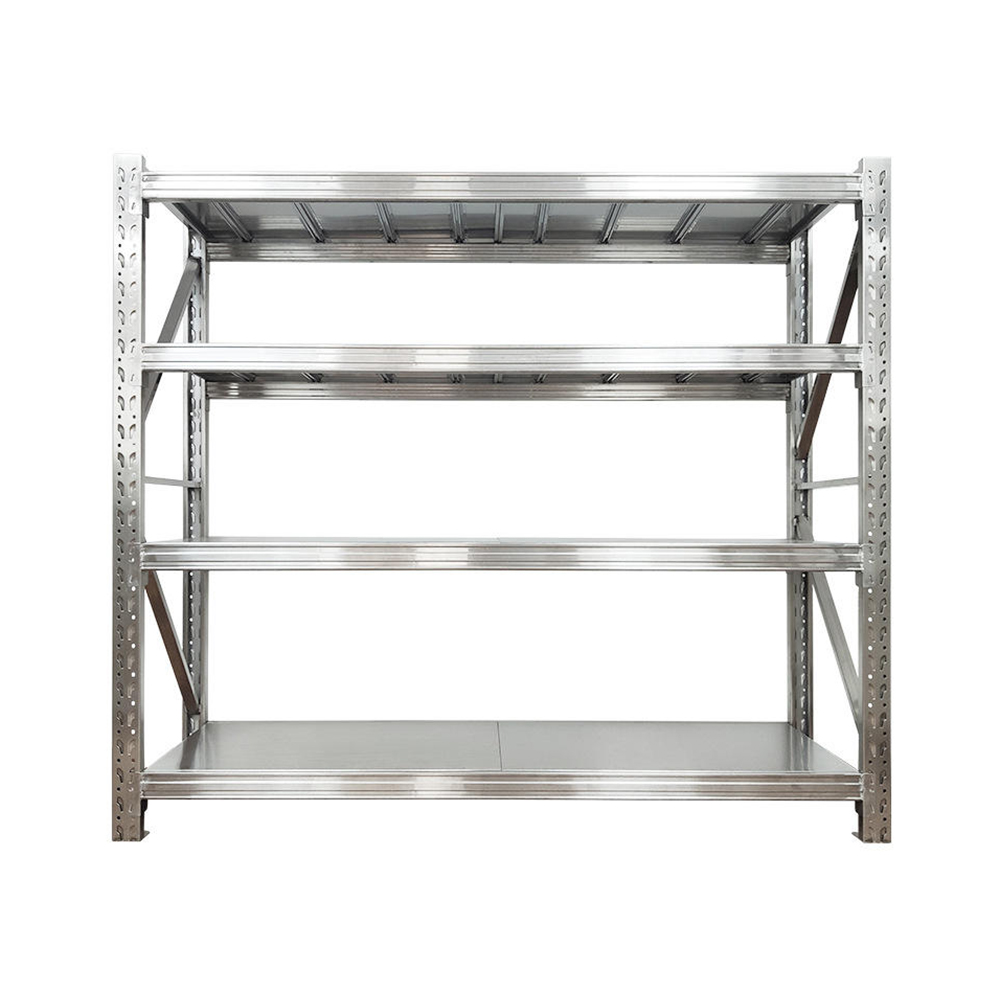
For factories and workshops, our medium duty steel storage rack with corrosion protection is a useful reference point for how mid-range gauge steel is normally specified when the environment is dusty, humid or lightly washed down. For heavier assignments, the design conversation moves from the bracket arm to the upright and beam, which we cover further below.
Nominal steel thickness by gauge and the shelving duties each gauge typically suits.
| Gauge |
Approximate thickness |
Common shelf duty |
Typical setting |
| 16 to 18 |
1.2 to 1.5 mm |
Very light storage, display tiers, decorative shelving |
Boutiques, homes, light back-of-store |
| 14 |
1.9 mm |
Light duty shelving, files, boxed stock |
Offices, small stores, archive rooms |
| 12 to 13 |
2.3 to 2.7 mm |
Medium duty shelving, hand-loaded parts |
Workshops, factories, warehouses |
| 10 to 11 |
3.0 to 3.4 mm |
Heavy duty arms, cantilever and beam connections |
Industrial storage, pallet and long-goods racking |
| 8 to 9 |
3.8 to 4.2 mm |
Structural connections, high-impact zones |
Heavy industrial racking, protected aisle ends |
A thicker gauge only helps until the hook, hole or fixing becomes the weakest point, so specify the bracket and its connection as one system, not as separate purchases.
How to Measure Shelf Brackets Before You Reorder
Replacement brackets are where most compatibility problems appear, because the frames and uprights are already fixed to the wall or standing in the aisle and cannot be adjusted. Reordering by photo or by a remembered part number is a reliable way to receive a carton of parts that are close but not identical. A five-minute measurement session prevents that.
- Measure the arm depth from the face of the mounting plate to the point where the shelf board ends, and record it in millimetres rather than in inches.
- Measure the height of the vertical leg or mounting plate, and note whether the leg sits behind the shelf board or beside it.
- Measure the hole pitch, the centre-to-centre distance between fixing holes, on both the vertical and horizontal faces. Pitch mismatch across a long run is the most common reason a batch of otherwise correct brackets wobbles.
- Record hole diameters and shape. Round holes sized for M6, M8 or M10 fixings, slots, keyhole shapes and square holes are not interchangeable, and slotted brackets have to be positioned so the slot does not sit under the highest load point.
- Note the material thickness at two places, on the arm and on the leg, since some suppliers reduce the leg thickness to save cost.
- Check orientation and handedness. Left and right versions, inward or outward lips, and hooks that engage from above or from the side all matter for fit.
- Record the finish and colour code, including whether it is powder coated, pre-galvanised, hot-dip galvanised or stainless, and whether the shelf contact surface is deburred or fitted with a protective strip.
When you write the specification, allow sensible tolerances and state them. Overall length and depth are often held within about one millimetre, and hole pitch within about half a millimetre on a well-controlled production line. On a one-metre shelving bay with four brackets, a pitch error of two millimetres accumulates into visible misalignment, and the installer solves it with force rather than with a tool, which is never a good outcome for the product or the wall.
It also helps to send a physical sample rather than only a drawing. A sample carries information that drawings lose: how the powder coat sits in the corner, how sharp the formed edge is, how the hook feels when it engages the slot, and how much spring the arm has. Suppliers who work on OEM and ODM programmes treat a sample as the reference standard for the whole order, which is exactly what you want when the second container has to match the first.
Measure depth, hole pitch, hole diameter, material thickness and handedness before you reorder, and send a physical sample so the reference standard survives into production.
Finish and Corrosion: How Long Metal Shelf Brackets Last
Finish is usually treated as a cosmetic choice, and in dry, air-conditioned offices it largely is. In a cold store, a food preparation area, a coastal warehouse or an unheated garage that swings between damp winters and warm summers, finish becomes a service-life decision, because corrosion starts at cut edges, weld zones and scratched contact points where the steel is unprotected.
Powder Coating
Powder coating is the most common finish on shelving brackets for good reasons: it is durable, available in standard colours, and it hides forming marks well. Coating thickness is normally specified in microns, with many shelving parts produced in a range around 60 to 80 microns, and performance often described through salt spray test hours. Typical commercial specifications sit between roughly 200 and 500 hours depending on pretreatment and powder chemistry. The variables that matter are pretreatment quality, coverage in recessed corners, and how well the coating survives handling and installation without chipping.
Galvanised Steel
Galvanised brackets protect steel with zinc rather than with a polymer film. Pre-galvanised sheet, coated before forming, is common for economy shelving and leaves exposed cut edges that rely on the surrounding zinc for protection. Hot-dip galvanising after fabrication gives a thicker, more sacrificial coating and is a frequent choice for outdoor or wash-down environments. If you need zinc coating weight stated on a drawing, express it as grams per square metre on both sides, because coating weight is what determines how long the protection lasts, not the colour of the surface.
Stainless Steel
Stainless shelving avoids the coating question altogether, but grade selection still matters. Grade 304 is the usual choice where moisture, cleaning chemicals or food contact are involved, while grade 201 is a lower-cost alternative with less nickel and correspondingly lower corrosion resistance in aggressive conditions. Our anti-corrosion stainless steel shelving for kitchen and warehouse storage reflects how these grades are normally applied in practice: kitchens, wet rooms and hygienic storage, rather than heavy outdoor exposure.
Two details are worth writing into any bracket specification regardless of finish. First, deburring: formed steel edges that are left sharp cut gloves, damage shelf boards and create a bad impression at installation. Second, weld treatment: weld spatter and uncoated weld zones are where rust shows first on painted brackets, and they are also where inspectors look first.
Choose the coating by environment, not by preference: powder coat for dry interiors, galvanised zinc for humid or outdoor exposure, and stainless where cleaning chemicals and food contact are routine.
Matching Shelf Brackets to Light, Medium and Heavy Duty Loads
Most shelving catalogues divide products into light, medium and heavy duty, and the bracket is where those categories become real. The dividing lines are not standardised across the industry, so treat the ranges below as practical guidance rather than fixed law, and always check the rating against the actual depth and fixing method you intend to use.
Light Duty Brackets
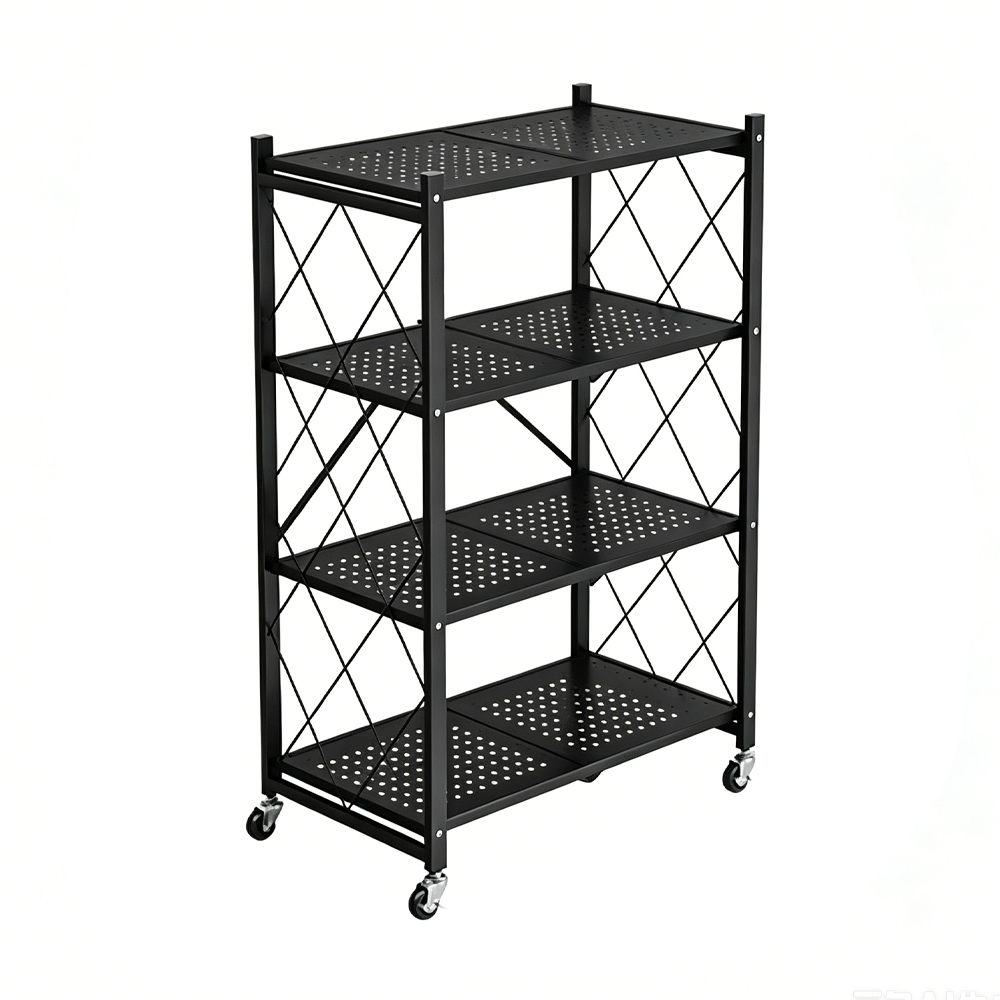
Light duty brackets typically support 30 to 80 kg per shelf level, use 14 to 18 gauge steel, and appear in offices, archives, retail back rooms, stockrooms and homes. Their weak points are usually thin legs and loosely toleranced slots rather than the arm itself. When you buy light duty shelving for an office or retail environment, insist on adjustable shelf positions, since the ability to move shelf levels is what makes a light system flexible enough to justify its cost. A well-made example is our four-layer adjustable light duty warehouse storage rack for offices and retail, where the bracket spacing is designed to be changed without tools.
Medium Duty Brackets
Medium duty brackets cover roughly 90 to 250 kg per level and are the workhorse specification for factories, workshops and general warehouse storage. Steel typically runs from 12 to 14 gauge, often with a folded profile that adds stiffness without adding a full gauge step. This is also the category where finish decisions start to matter, because factories are frequently dusty, humid or washed down, and an unprotected cut edge will show rust within a season.
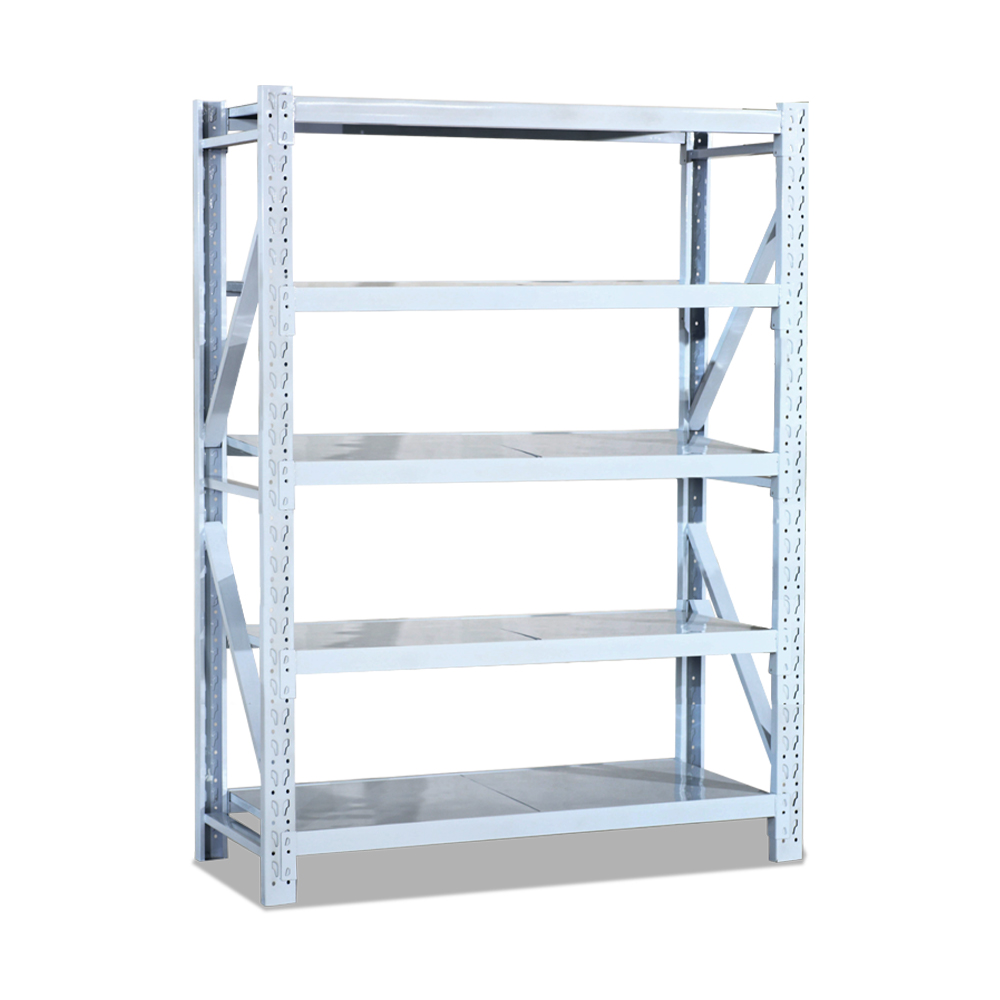
A typical specification in this band pairs a corrosion-protected steel upright with brackets formed to hold hand-loaded parts, cartons and tooling. Our medium duty steel storage rack with corrosion protection for factories is built around exactly that balance: enough stiffness for repeated daily loading, with a surface treatment that survives workshop conditions rather than only looking correct in a showroom.
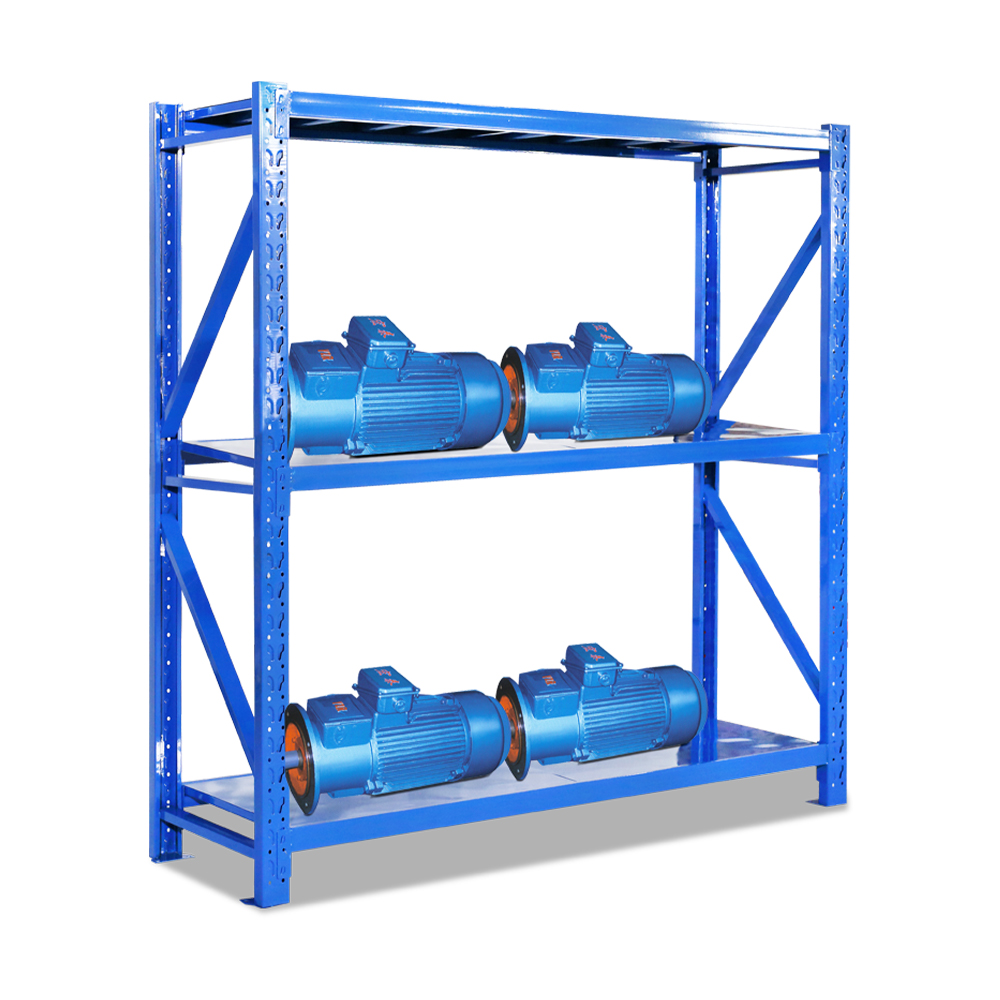 Medium Duty Steel Storage Rack with Corrosion Protection for Factory Warehouse Stacking Sh·Load capacity: 200-500kg per layer ·Multi-bent beams for improved strength ·One-piece shelf edge for safety ·Reinforced steel shelf panels ·Butterfly hole structure f...View Product →
Where Heavy Duty Begins
Above roughly 300 kg per level, the bracket stops being the primary structural element. Loads of that size are normally carried by beams that engage uprights directly, with brackets or arms playing a connecting or supporting role. The design logic shifts from "how thick is the bracket" to "how does the connection behave under repeated loading, and how is it protected from forklift impact". We come back to that in the next section.
Light, medium and heavy duty are not just gauge differences; each band changes which part carries the load, and the bracket stops being the critical element once loads pass roughly 300 kg per level.
Heavy Duty Racking: Where Shelf Brackets Meet Warehouse Loads
In a pallet racking installation, the parts that look like brackets are usually beam connectors, cantilever arms or support brackets, and they are engineered as part of a system rather than as an accessory. A beam connector has to engage the upright reliably every time, resist upward dislodgement when a pallet is placed unevenly, and tolerate the small deflections that occur when a forklift sets down a load.
Three practical points separate heavy duty work from ordinary shelving. First, capacity is expressed per level and assumes evenly distributed loads; a single dense pallet in the middle of a beam changes the stress pattern considerably. Second, impact protection matters more than theoretical strength, because most rack damage comes from handling equipment rather than from overload. Third, inspection has to be routine, with a written interval and a clear rule for what counts as damage worth replacing rather than monitoring.
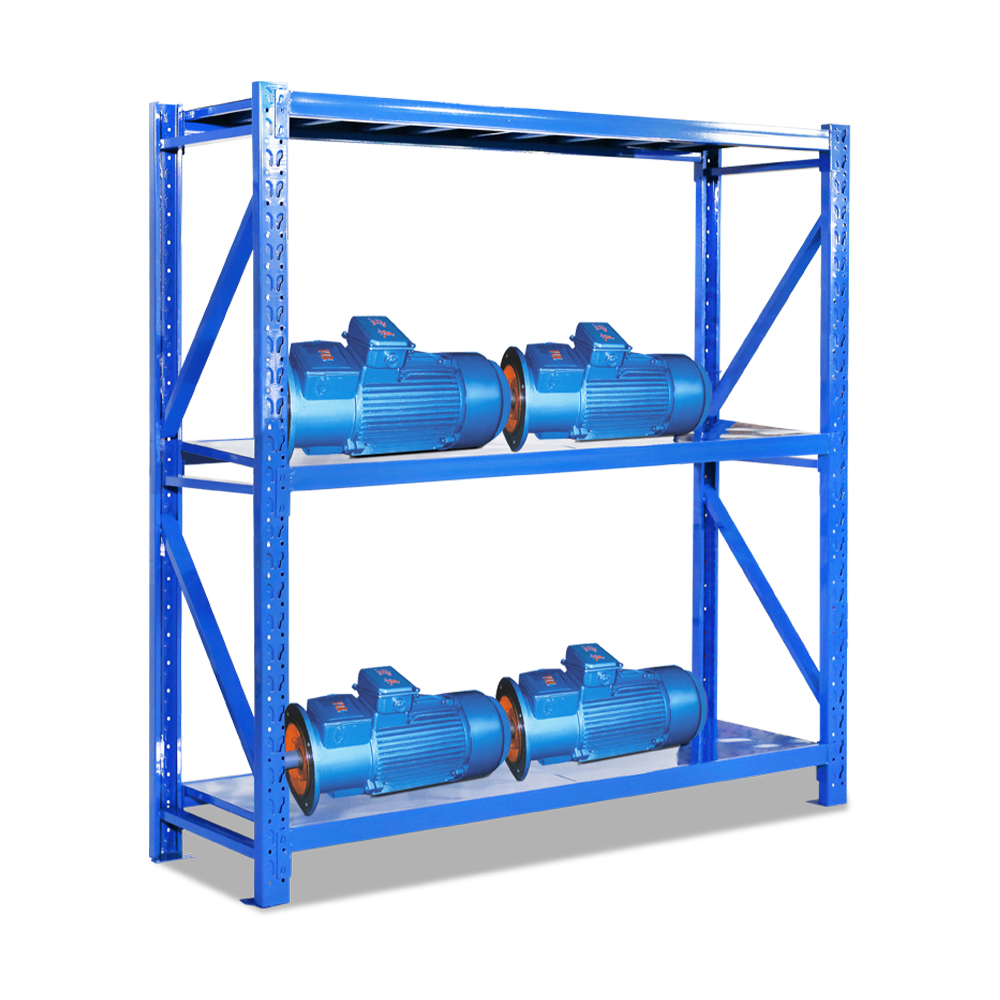
For industrial storage, the design conversation usually involves upright capacity, beam length, decking options and accessory brackets for irregular goods. Our heavy duty steel storage rack for industrial warehouse storage is representative of how this combination is normally delivered: upright frames and beams rated as a set, with support brackets and safety elements supplied to the same specification rather than sourced separately. Cantilever arms follow the same principle for long goods such as pipes, timber and profiles, where the arm has to resist both the weight and the leverage of material extending beyond the rack face.
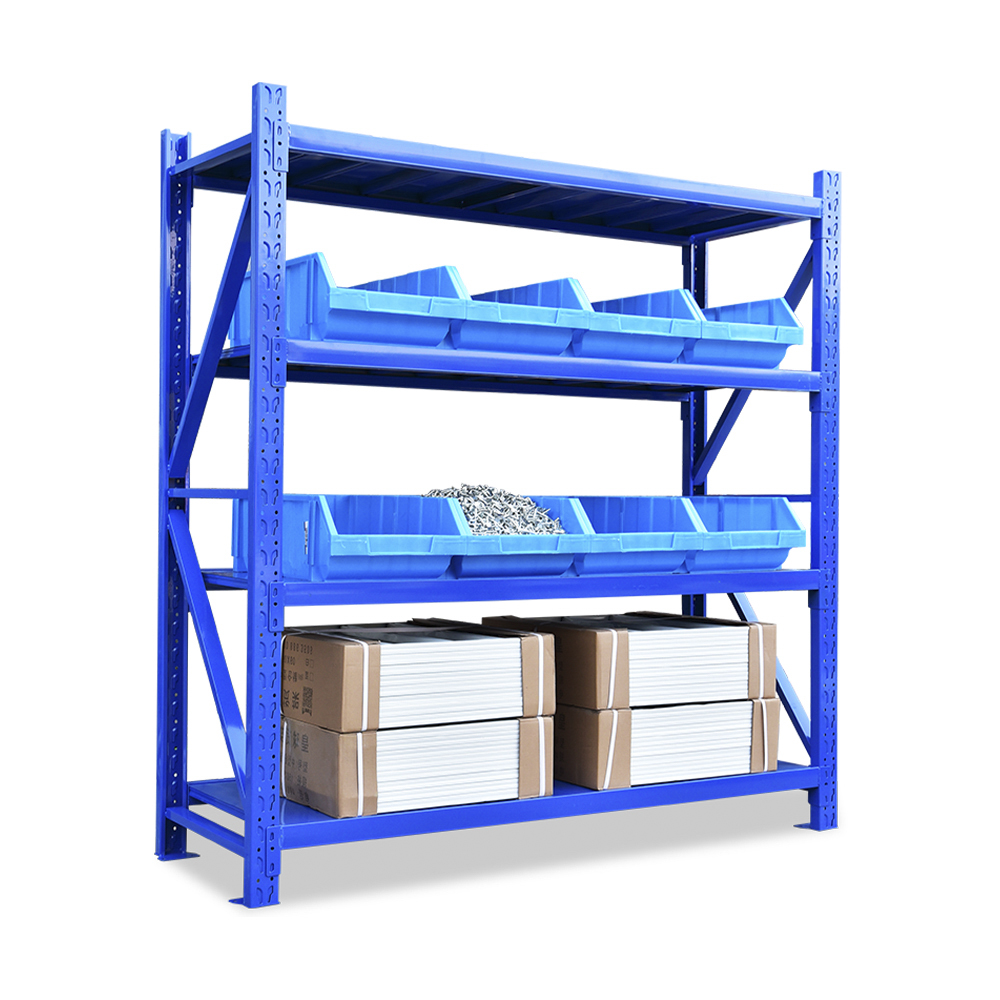 Heavy Duty Steel Storage Rack for Industrial Warehouse Storage·Load capacity: 500kg+ per layer ·Diamond or inverted-8 hole uprights for quick installation ·Multi-folded beams increase load capacity by 20%View Product →
Buyers often ask whether heavy duty brackets can be used on medium duty frames. Mechanically the parts may fit, but the rating belongs to the weakest element in the assembly, which will normally be the upright, the base plate or the floor fixing. Mixing duty classes inside one bay is one of the fastest ways to create an installation that no supplier can certify and no inspector can accept.
In heavy duty racking, the rated capacity belongs to the complete bay, so brackets and arms must be specified with the uprights, beams and floor fixings they will actually be installed on.
Bracket Design for Retail and Display Shelving Systems
Retail shelving looks like a different product family, but the bracket logic is the same, with one addition: appearance. A shop bracket is seen from the aisle, carries lighter loads, and has to align with price strips, dividers and display accessories that were designed around a specific slot pitch. The common pitches in the market, such as 25 mm, 32 mm and 50 mm spacing, are not interchangeable, and a bracket designed for one pitch simply will not sit level in another.
Display brackets also need to handle shelf types that differ from a plain board. Glass shelves require flat, protected contact surfaces and often a locating pin to stop the glass sliding. Wire grids, acrylic trays and hanging rails put their load in different places and need brackets shaped for those accessories. In convenience stores and small-format retail, the ability to change shelf heights quickly matters more than maximum capacity, because the layout changes with every seasonal promotion.
Our multi-tier shelf display rack for supermarkets is built around those retail priorities: consistent slot pitch across the range, adjustable levels, and a finish that stays presentable where customers walk past it all day. The same design discipline applies to checkout and service counters, where support brackets sit inside a closed unit and their accuracy is invisible but still determines whether the counter top sits flat.
 Shelf Display Rack for Supermarket·Compact and space-saving; eye-catching design to attract customers; ·Adjustable layers and angles; easy to assemble and move; ·Suitable for small to medium-sized prod...View Product →
One detail worth insisting on for retail work is batch consistency. When a chain refits twenty stores over two years, brackets from a later production run have to match the earlier one in pitch, hook shape and colour, otherwise the parts look mismatched on a gondola run and staff start swapping shelves between bays to hide it. Colour matching and pitch control belong in the purchase specification, not in a verbal request.
Retail brackets are judged on slot pitch consistency, accessory compatibility and colour matching across production batches, because appearance is part of the function in a shop.
Standard vs Custom Shelf Brackets: What Changes at Scale
Most shelf brackets are bought as standard parts, and that is usually the correct decision. Custom brackets make sense when an existing installation cannot be modified, when a bracket has to integrate with equipment you already own, or when a branded shelving range needs a distinctive profile. Custom work is also common in OEM and ODM programmes, where the bracket carries another company's design language or fits a fixture developed by their engineering team.
The trade-off is not only price. Custom brackets involve tooling, first-article approval, sample rounds and longer lead times, and those costs have to be absorbed across the order quantity. The table below compares the two routes across the variables that usually decide the question.
Standard and custom shelf brackets compared across the variables that most often decide a purchase.
| Variable |
Standard bracket |
Custom bracket |
| Dimensions |
Fixed range of depths, heights and hole patterns |
Built to your drawing or sample within production tolerances |
| Tooling |
None; existing press tooling |
New tooling or modified tooling, amortised across the order |
| Minimum order |
Usually low, and can be combined with other items |
Higher, because setup time and material runs are dedicated |
| Lead time |
Shorter, often from existing stock or a current production run |
Longer, including sampling and first-article approval |
| Unit cost |
Lower at small volumes |
Higher at small volumes, competitive at large volumes |
| Flexibility |
Limited to catalogue options |
Finish, gauge, pitch, profile and branding can all be set |
| Documentation |
Catalogue data and standard drawings |
Approved drawings, sample sign-off and inspection criteria |
If you are importing as a wholesaler or supplying your own retail brand, the decision usually comes down to whether the bracket difference is visible or functional. If it is purely cosmetic, a standard bracket in the right colour is nearly always the better commercial choice. If it changes how a shelf fits, how a bay is assembled, or how a fixture works with equipment you cannot replace, custom development pays for itself in avoided rework.
Go custom only when the bracket affects fit or function; if the difference is cosmetic, a standard part in the correct colour usually wins on cost, lead time and risk.
Sourcing Shelf Brackets: A Buyer's Checklist for Importers and Wholesalers
Sourcing brackets is deceptively simple because the part is small. The complications come from volume, from the number of variants in a single order, and from the fact that a two-millimetre deviation is invisible in a photo but obvious on an installed bay. The checklist below reflects the questions that most often separate a smooth first order from a container of returns.
What to Put in the Request for Quotation
- A drawing or sample for each variant, with dimensions in millimetres and tolerances stated rather than implied.
- Steel grade and gauge for both the arm and the leg, not just for the part overall.
- Hole pitch, hole diameter and hole shape, plus any slot requirements and their orientation.
- Finish, colour reference and coating thickness or zinc weight where relevant.
- Load expectation per bracket pair, including the depth at which that load will be applied.
- Order quantity per variant, packaging requirements, and whether parts will be shipped as spares or kitted with shelving.
- Labelling and barcode needs if the brackets are going into a distribution network rather than directly to a site.
What to Check on Incoming Inspection
- Dimensional check against the approved sample, focusing on hole pitch, depth and leg height.
- Material thickness verification at several points, since thickness reduction is the most common silent cost saving.
- Weld and hook condition, including engagement depth and freedom from spatter and sharp edges.
- Coating coverage in corners and at cut edges, plus a colour comparison against the approved reference.
- Packaging integrity, because damaged edges create rust spots before the goods reach the customer.
It also helps to discuss the second and third orders during the first one. A supplier who understands that the same bracket will be reordered for two years will plan production accordingly, hold tooling in good condition, and keep colour records on file. We work this way with importers, wholesalers and brand owners, and you are welcome to send us your bracket drawings or samples for a quotation, whether you need one spare variant or a full shelving range with matching accessories.
A good bracket order is defined by the tolerances, gauges, coating weights and inspection points written on the drawing, not by what appears in the product photo.
Five Costly Mistakes With Metal Brackets for Shelves
Most bracket problems are predictable, and they are usually caused by a decision made early in the project rather than by the supplier. These five appear most often in both new installations and reorders.
- Buying by appearance. A bracket that looks identical in a photograph can differ by a millimetre of hole pitch or half a gauge of steel, and neither shows in a picture.
- Mixing duty classes inside one bay. Using heavy duty brackets on light duty uprights moves the failure point to the weakest element and removes any meaningful rating from the assembly.
- Ignoring the substrate. A high-capacity bracket fixed into plasterboard with the wrong anchor has a real capacity far lower than its label, and the failure will look like a wall problem rather than a bracket problem.
- Specifying by gauge alone. Profile design carries load more efficiently than extra thickness, so a well-formed 12 gauge bracket can outperform a flat 11 gauge part.
- Reordering without a reference sample. Once the original batch is installed, the only reliable standard for the next order is a physical part kept aside for exactly that purpose.
There is a sixth mistake worth mentioning because it affects perception rather than safety: treating the finish as an afterthought. Rust blooming at a weld on a newly installed shelf undermines confidence in the entire shelving system, even when the structural parts are perfectly adequate. A supplier who discusses pretreatment, coating coverage and edge protection without prompting is usually a supplier who handles dimensional tolerances properly too.
Keep one approved sample bracket from every batch on file; it is the cheapest insurance against a reorder that does not fit the frames already installed on site.
FAQ: Metal Brackets for Shelves
What gauge steel should metal brackets for shelves be?
It depends on the load and the depth of the arm. Brackets around 14 gauge suit light storage such as files and boxed stock, 12 to 13 gauge suits medium duty workshop and warehouse shelving, and 10 gauge or thicker is normal where arms are long or loads are heavy. Depth matters as much as gauge, so check the rating at the depth you actually intend to use.
How much weight can a pair of shelf brackets hold?
Commercial brackets commonly range from around 40 kg per pair for light duty parts to over 200 kg per pair for heavy duty designs, always assuming a sound fixing and a moderate arm depth. Ratings assume the load is spread across the shelf rather than concentrated at the front edge, and a long arm or a weak wall will reduce the real figure.
Are metal brackets for shelves strong enough for a garage or small warehouse?
Yes, provided the duty class matches the load and the brackets are fixed into a suitable substrate such as masonry or structural timber. For hand-loaded cartons and tools, medium duty shelving with 12 to 13 gauge brackets is usually sufficient. For palletised or machine-loaded goods, the installation should move to racking rated as a complete bay.
What is the difference between 201 and 304 stainless shelf brackets?
Grade 304 contains more nickel and offers better resistance to moisture, cleaning chemicals and food contact, which is why it is the usual choice in kitchens and wet areas. Grade 201 is a lower-cost option with lower corrosion resistance and is better suited to dry or lightly humid indoor environments.
Can metal brackets for shelves be made to custom dimensions?
Yes. Custom brackets are produced from a drawing or a physical sample, with the gauge, hole pitch, profile, finish and branding set to your requirement. Custom work normally involves tooling and a sample approval stage, so it becomes commercially sensible at larger order quantities or where the bracket has to fit existing fixtures.
How do I measure hole pitch on a shelf bracket?
Measure centre to centre between two adjacent fixing holes on the same face, and repeat on both the vertical and horizontal faces. Do this on several brackets from the batch, not just one, and record the hole diameter as well, since a bracket with the right pitch and the wrong hole size will still not fit properly.
What is the minimum order for custom shelf brackets?
It varies with the profile, the tooling required and the finish, and it also depends on whether the bracket can be produced alongside other parts in the same run. Sharing drawings and expected annual volumes early usually produces a more realistic answer than asking for a single figure out of context.
Do suppliers offer brackets as part of complete shelving systems?
Established shelving manufacturers normally supply brackets, uprights, beams, decking and accessories to a single specification, which is the safest route because the capacity belongs to the whole assembly. Buying brackets separately from the frames is possible, but it puts the compatibility check on the buyer.
When in doubt, specify the bracket with the frames it will be installed on and let one manufacturer take responsibility for the rating of the complete bay.
Metal brackets for shelves are inexpensive parts with an outsized influence on how a storage or display installation performs. The steel gauge sets the stiffness, the hole pattern decides whether the part fits what is already on site, the coating decides how long it stays presentable, and the fixing decides whether any of it can be trusted. Buyers who treat those four elements as one specification rarely have bracket problems; buyers who treat the bracket as a commodity detail usually meet them later, in the aisle.
If you are planning a new shelving programme, replacing damaged brackets across an existing estate, or developing your own branded shelving range, the most useful first step is a clear drawing plus a reference sample. From there, gauge, profile, finish and packing can all be settled before the first container is loaded.
Explore Our Shelving and Storage Programme
From light duty adjustable shelving for offices and retail back rooms to medium duty workshop racks, heavy duty industrial racking, supermarket display systems and stainless steel shelving for kitchens and wet rooms, our range is built around the same bracket and connection standards. See how the systems fit together across the industries we supply, then send your drawings and quantities for a quotation.
Specify gauge, fixing pattern, coating and load expectation together, and a small steel bracket stops being the part of the project that keeps coming back.



 English
 Español
 русский
 Français
 한국어
 عربى
 ไทย
 Deutsch
 Bahasa Melayu
 Português
 Polskie