A store manager in a mid-sized garment shop once described inventory changeover as a two-person, twenty-minute wrestling match with a fixed clothing rail. In warehouses, the same scene plays out with returned garments, uniform lots, and new season stock that has to travel from receiving to storage to the sales floor. Home users face a smaller version of the problem when the seasonal wardrobe swap leaves coats, suits, and dresses piled on chairs because the closet rail cannot expand. The practical solution is to bring in clothes racks on wheels: freestanding hanging frames with casters that move the entire load, garments still on hangers, from one point to another without lifting or folding.
Hold this conclusion in mind before comparing options: the right clothes rack on wheels is the one whose load capacity matches your heaviest realistic hanging inventory, whose casters suit your floor type and rolling distance, whose brakes hold reliably, and whose frame does not flex when fully loaded. Colour, extra shelves, and decorative details are secondary to these four mechanical facts.
This guide approaches rolling garment racks from a practical and industrial angle. It covers the main product types, load and caster engineering, frame materials and corrosion protection, application-specific selection for retail, warehouse, and home use, and a realistic maintenance routine. It also discusses what it means to buy from a manufacturer when you need standard supply, wholesale quantities, or custom dimensions for a branded retail chain.
Key conclusion: A clothes rack on wheels is a system of frame, casters, and finish; choose them together, not as separate afterthoughts.
What Are Clothes Racks on Wheels and Why Mobility Matters
A clothes rack on wheels, also known as a mobile garment rack, rolling clothes rail, or clothing caddy, is a steel or metal frame fitted with one or more horizontal hanging rails and supported by caster wheels. It holds garments on hangers at a height that keeps hems off the floor, preserves the shape of coats and suits, and makes every item visible for quick selection. The defining difference from a fixed wardrobe rail is that the whole structure moves: a loaded rack can be pushed to a different room, corner, or workstation in seconds.
Mobility changes the way a space works. In a retail store, the floor layout can be re-planned in minutes by rolling display racks into a new arrangement. In a warehouse, a single rack can serve several picking zones and then be rolled into a staging area for outgoing orders. In a laundry or garment factory, finished items move from the ironing station to the packing line without being folded and refolded. At home, a rolling rail doubles as extra closet space and as a portable wardrobe for seasonal rotation.
The practical advantages add up quickly:
- Faster stock transfer: receiving, stockroom, and sales floor become one connected workflow.
- Less handling: garments stay on their hangers, so wrinkles, snags, and fitting-room damage are reduced.
- Flexible floor plans: retail displays, exhibition booths, and storage rooms can be rearranged without tools.
- Better inventory visibility: open rails make it easy to count, tag, and photograph stock.
- Space efficiency: a mobile rack stores vertically and can be rolled into a compact area overnight.
For retailers, garment wholesalers, and logistics teams, the mobile rack is not furniture; it is a workflow tool. The choice of frame strength and wheel quality determines whether that tool saves time or creates a new bottleneck. A flimsy rack with small wheels will jam on a door threshold, bend under a full rail of coats, and eventually end up parked in a corner. A correctly specified rack, by contrast, stays straight, rolls smoothly, and pays for itself within the first season of use.
Key conclusion: Mobility is the core value, but it only works when the frame is rigid enough and the casters are strong enough for the actual load.
Main Types of Clothes Racks on Wheels
Not all mobile garment racks are the same, and the differences matter more than the outward appearance suggests. The main categories are defined by the number of rails, the frame gauge, the way the rack is assembled, and the intended setting. Understanding these types helps you match a rack to the task instead of buying on looks alone.
Light-Duty Single-Rail Racks
The most common consumer model has one rail, four small swivel casters, and a simple A-frame or H-frame structure. It is perfectly adequate for a bedroom, a studio apartment, or a small office where 20 to 40 garments are stored. The rail is usually 90 to 120 cm long and the capacity rarely exceeds 50 kg.
Heavy-Duty Double-Rail Racks
Industrial and warehouse versions use thicker steel tube, a stronger cross-brace, and two parallel rails so that more garments can hang without overloading a single point. These racks typically carry 120 to 250 kg and are fitted with larger casters, often 75 mm or 100 mm, two of which have brakes. They are the standard choice for stockrooms, uniform rooms, and garment returns operations.
Retail Display Racks
Boutiques and department stores use racks that combine display quality with mobility. These models tend to have a cleaner finish, optional brand panels, and slightly lower load ratings because they are moved frequently and need to look presentable on the sales floor. A well-built retail display rack on wheels can hold 50 to 80 kg while still being light enough for one person to push.
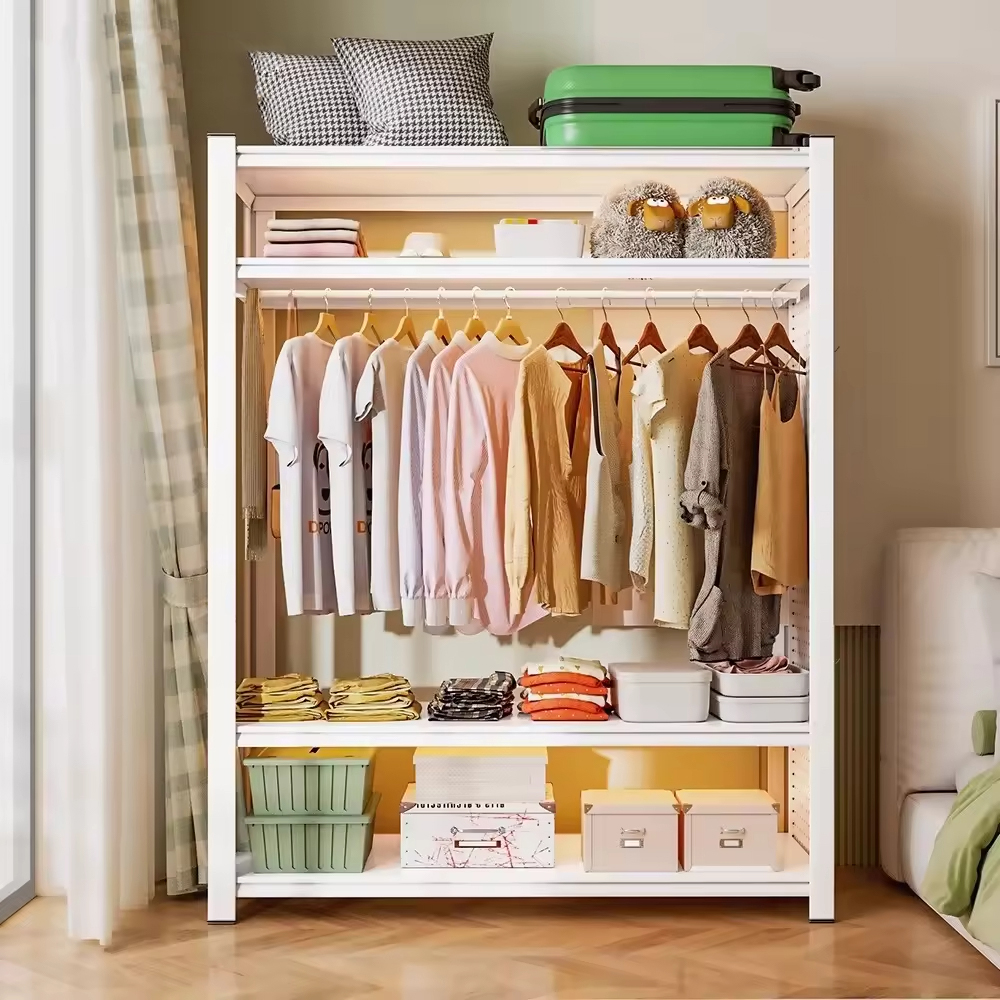 Portable Folding Garment Rack with Wheels for Temporary DisplaysThis collapsible wheeled rack suits exhibitions and pop-up markets, offering easy transport and flat storage. Its adjustable hanging rods accommodate various garments while remaining light enough for one person to manage.View Product →
Folding and Portable Racks
For exhibitions, pop-up markets, and temporary storage, a folding garment rack with wheels is the most practical option. The frame collapses flat for transport, and the wheels fold or detach. Capacity is lower, usually 20 to 40 kg, and the wheels are smaller than on industrial models. These racks are not intended for permanent daily movement of heavy loads.
Multi-Tier Racks with Shelves
Some mobile racks add one or two flat shelves beneath the hanging rail for folded knitwear, shoes, handbags, or packing materials. This combination is popular in laundries, hotel back-of-house areas, and retail stockrooms where hanging items and folded items arrive together. The extra shelf adds weight, so these racks are usually built with a stronger base frame.
The table below summarizes the practical differences between these categories.
Table 1. Common clothes rack categories on wheels and their typical capacity range.
| Rack Type |
Typical Load |
Wheel Configuration |
Best Use |
| Light-duty single rail |
25-50 kg |
4 small swivel casters, 40-50 mm |
Home closets, office coat storage |
| Heavy-duty double rail |
120-250 kg |
4-6 casters, 75-100 mm, two with brakes |
Warehouse picking, stockrooms, uniform rooms |
| Retail display rack |
50-80 kg |
4 swivel casters with brakes |
Boutique sales floor, pop-up displays, window changes |
| Folding portable rack |
20-40 kg |
4 small casters, often detachable |
Exhibitions, markets, temporary storage |
| Multi-tier rack with shelves |
80-150 kg |
4-5 casters, lower-profile wheels |
Laundry services, combined hanging and folded storage |
When you move from consumer to industrial categories, pay attention to the rail attachment points. A rail that is only clamped to two uprights will rotate under uneven loading. A rail that is welded or bolted through a reinforced gusset stays level when heavier coats are clustered at one end. This detail separates a rack that feels solid after two years from one that starts sagging after two weeks.
Key conclusion: The category name tells you where the rack is intended to be used; the frame construction and caster size tell you whether it will survive that use.
Load Capacity and Wheel Performance: What the Numbers Mean
Load rating is the first specification buyers ask about, and for good reason. It tells you the maximum weight the frame can support under normal static conditions, usually expressed in kilograms. Dynamic load, which applies when the rack is being pushed, is always lower than static load. Wheel performance is equally important because a rack that carries 200 kg but rolls poorly is useless in daily operation. The chart below summarizes typical load ranges for common categories of mobile garment racks so you can match the number to your actual hanging inventory.
The load ranges show a clear pattern: single-rail consumer racks cluster at the low end, while double-rail and industrial models carry significantly more. If your wardrobe consists mostly of shirts, blouses, and light jackets, a 50 kg capacity is usually sufficient. Winter coats, suits, and bulk denim change that calculation quickly. A heavy winter coat can weigh 1.5 to 2.5 kg, so 30 coats already reach 45 to 75 kg. For a retail store that moves inventory between the stockroom and the sales floor, a 120 kg rack handles a full rolling rail of outerwear without bending. For warehouses that store returned garments, uniforms, or packaged apparel, 200 kg or more is a safe starting point.
Casters matter as much as the frame. A swivel caster makes turning easy, while a rigid caster keeps the rack tracking straight. Four swivel casters give the best maneuverability in tight spaces, but they can make a long rack harder to control in a straight line. Two fixed and two swivel casters strike a middle ground that many warehouse operators prefer. Brakes are not optional for retail use; at least two of the four wheels should lock so the rack cannot roll away while stock is being hung. Wheel diameter is another factor: 40 mm wheels are fine for smooth store floors, while 75 mm or 100 mm wheels roll smoothly over warehouse joints and thresholds. Polyurethane (PU) or thermoplastic rubber (TPR) wheels are quiet and kind to floor surfaces, whereas nylon wheels are harder and better suited to concrete. Durability also depends on the caster bracket; a stamped steel bracket can flex under heavy loads, so look for a reinforced or welded bracket on industrial models. The takeaway is that capacity and casters must be considered as a system, because a strong frame on weak wheels will still feel unstable in use.
Load Distribution and Point Loading
Most manufacturer ratings assume the load is distributed evenly along the rail. In real life, that is rarely true. A rack full of padded hangers concentrates weight at the hook points, and a row of heavy coats at one end creates point loading that stresses the rail joint. When evaluating a rack, check the rail-to-upright connection rather than only the total capacity number. A rack rated at 150 kg with a weak centre joint can deform at 80 kg if the weight is clustered.
Table 2. Caster features to compare before buying a mobile garment rack.
| Caster Feature |
Light-Duty Models |
Heavy-Duty Models |
| Wheel diameter |
40-50 mm |
75-100 mm |
| Wheel material |
Nylon or hard plastic |
PU or TPR, sometimes with ball bearings |
| Swivel/rigid combination |
Usually all swivel |
Two swivel plus two rigid, or four to six swivel with brakes |
| Brake type |
Simple wheel brake |
Double-lock brake (wheel plus swivel) |
| Load per caster |
15-25 kg |
50-90 kg |
The caster table reinforces the same point: wheel hardware is rated independently of the frame. If a rack has four casters rated at 20 kg each, the rolling system supports roughly 80 kg even if the frame claims 100 kg. When buying for retail or warehouse use, ask the supplier for the per-caster load rating and the brake type. These two details are reliable indicators of whether the rack was designed for daily movement or only occasional repositioning.
Key conclusion: Match the total capacity rating to your heaviest real load, and make sure the caster rating and brake quality match the floor and the frequency of movement.
Frame Materials, Finishes, and Corrosion Resistance
The frame material decides how long a mobile garment rack keeps its shape and appearance. Most racks on the market are made from steel tube, but the grade of steel, the wall thickness, and the surface treatment vary enormously between consumer and industrial products. A rack that looks identical in a photograph can be built from 0.8 mm tube or 1.5 mm tube, and the difference shows up in the first year of use.
Cold-Rolled Steel with Powder Coating
Cold-rolled steel is the standard material for quality racks because it is strong, formable, and can be welded cleanly. After forming, the frame is cleaned, treated, and coated with a baked powder finish. Powder coating is far more durable than liquid paint; it resists chipping, scratching, and fading, and it forms a continuous protective layer over the steel surface. For normal indoor use, this finish is sufficient for many years.
Chrome-Plated Frames
Some racks, especially retail display models, use chrome-plated steel. Chrome gives a bright, polished look, but it is softer than powder coating. Scratches expose the base metal and rust can start at the damaged area. Chrome racks are best reserved for low-humidity environments where appearance is the priority.
Stainless Steel Frames
For coastal areas, commercial laundry rooms, and applications where the rack is wiped down frequently, stainless steel is the safer choice. Grade 304 stainless steel resists oxidation and is easy to sanitise. Stainless steel racks cost more, but the service life in humid conditions is dramatically longer. A powder-coated carbon steel rack that rusts within two years near the sea can be replaced by a stainless steel rack that lasts a decade.
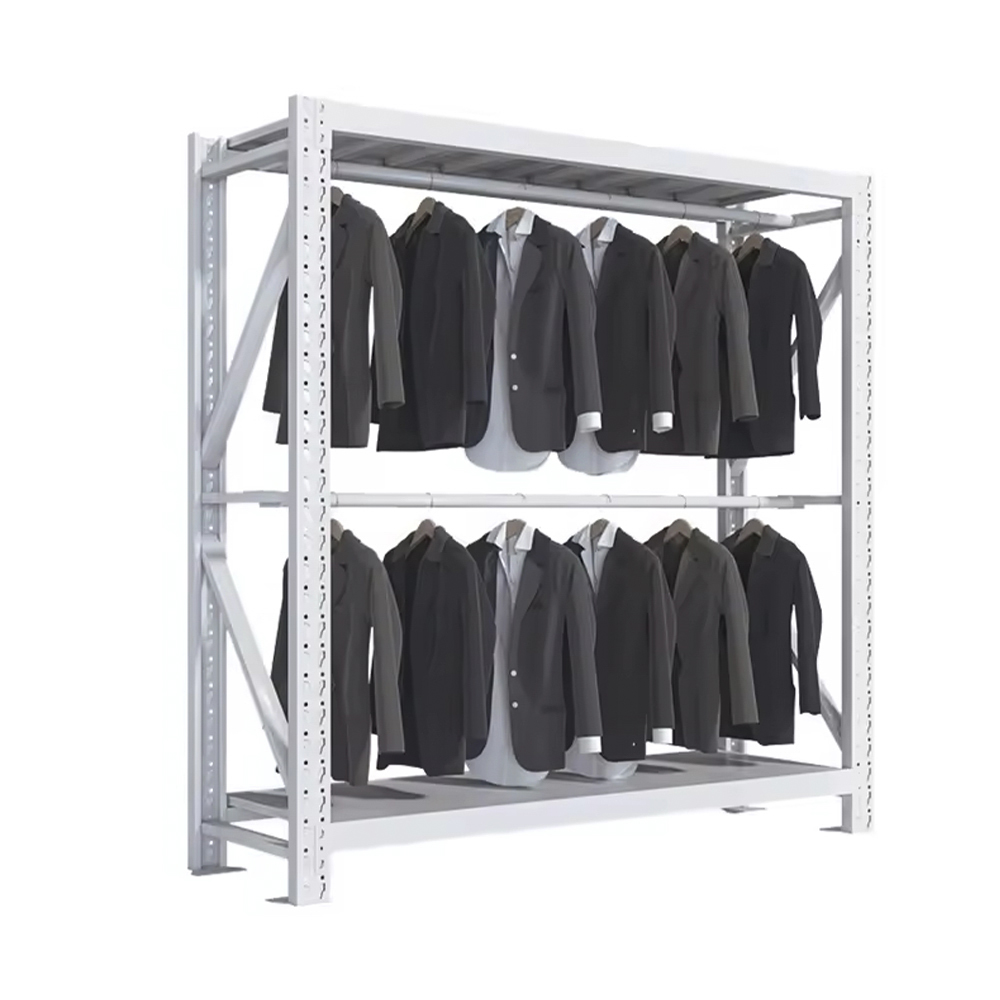 Corrosion-Resistant Steel Clothing Rack for Humid EnvironmentsDesigned for coastal or high-moisture settings, this rack uses protective steel construction to resist rust and oxidation. Adjustable rods and a stable frame make it a durable storage choice where frequent wiping or sanitising occurs.View Product →
Surface Treatment Details to Inspect
Whatever the coating, the quality of the pre-treatment determines whether the finish will last. Look for even coverage at the joints, no bare spots near welds, and smooth edges without sharp burrs. Fittings, bolts, and casters should be zinc-plated or stainless to avoid rust stains dripping onto garments.
Table 3. Frame and finish options for clothes racks on wheels.
| Material / Finish |
Corrosion Resistance |
Typical Application |
| Cold-rolled steel plus powder coating |
Good in dry indoor conditions if coating is intact |
Most standard home, retail, and warehouse racks |
| Chrome-plated steel |
Moderate; scratches expose base metal |
Retail display racks with polished appearance |
| Stainless steel (grade 304) |
Excellent in humid, coastal, or washdown areas |
Commercial laundry, coastal shops, food environments |
| Zinc-plated fittings |
Good for small parts; prevents rust staining |
Bolts, nuts, caster brackets |
Buyers who operate in coastal cities, tropical climates, or facilities with open loading doors should take corrosion seriously. Humidity and salt air attack unpainted edges first. Facilities that steam garments or clean racks with chemical sprays need finishes that can tolerate repeated exposure. When ordering wholesale, it is reasonable to ask the manufacturer for a corrosion test report or a description of the pre-treatment process, because this part of production is invisible in the final product photograph.
Key conclusion: The finish is not a cosmetic detail; it is the first line of defence against rust, and the right material choice doubles or triples the useful life of a rack in humid conditions.
How to Choose a Clothes Rack on Wheels for Retail, Warehouse, and Home
Selection starts with the operating environment, not with the product photo. A rack that serves a boutique sales floor beautifully may be too light for a warehouse picking line, and an industrial double-rail rack is overkill in a bedroom. The following guidance matches common use cases with the specifications that matter most in each.
Retail Stores and Pop-Up Shops
Retail racks move almost every day. Staff roll them between the stockroom and the floor, re-arrange displays for new arrivals, and push them into storage overnight. Priorities are easy rolling on smooth surfaces, reliable brakes, and a polished appearance that does not clash with the merchandise. A retail display rack with four swivel casters and PU wheels is usually the right balance. Avoid hard nylon wheels on tiled floors because they are noisy and can leave scuff marks.
Warehouses, Stockrooms, and Uniform Rooms
These environments demand capacity and durability over appearance. The floor is likely concrete, so wheels need to be larger and harder-wearing. A double-rail heavy-duty rack with 75 mm or 100 mm casters, at least two brakes, and a reinforced base is the safe choice. If the rack will be moved several times a day across a larger area, consider a model with two rigid casters for straight-line control.
Home and Office Use
At home, the priorities are footprint, quiet rolling, and enough capacity for a seasonal wardrobe. A light-duty single-rail rack or a folding model works well on carpet because it is small and easy to push. Look for wheels with soft TPR tread that do not damage wooden floors. A 50 kg capacity is realistic for daily clothing; if you hang coats, take the 80 kg class instead.
The two-column comparison below summarises the selection logic.
Table 4. Application scenarios and corresponding selection priorities for clothes racks on wheels.
Application scenarios
Retail sales floor: frequent movement, visual display, brake reliability, noise sensitivity.
Warehouse and stockroom: high loads, concrete floor, long pushing distances, straight-line tracking.
Home and small office: compact footprint, carpet-friendly wheels, light to medium loads, occasional moves. |
Selection priorities
Choose display-grade steel, PU or TPR wheels, and double brakes for retail.
Choose double-rail construction, 75-100 mm casters, a rigid and swivel mix, and reinforced brackets for warehouses.
Choose light-duty or folding frames, soft wheels, and easy assembly for home use. |
Beyond the basic type, configuration choices affect how the rack is used every day. For example, a single rail keeps all garments visible but limits total capacity; a double rail doubles the hanging length without increasing floor space; a bottom shelf provides a place for shoes, folded knitwear, or packing boxes; and side panels can carry brand graphics in retail. The horizontal list below shows the most common configurations.
When you operate across multiple locations, standardising on one or two rack models simplifies maintenance, spare-part stock, and staff training. This is where working with a single manufacturer instead of buying scattered consumer items makes a visible difference. A manufacturer can keep a consistent specification across batches, supply matching spare casters, and adjust rail length, colour, or branding for your chain.
Our industry solutions pages show how the same storage product family is configured for different sectors, from garment retail to warehouse logistics. Reviewing those examples helps you see the range of options before you commit to a specification.
Key conclusion: Choose the rack based on floor conditions, movement frequency, and realistic load, then standardise one configuration across all locations to simplify support and spare parts.
Maintenance and Safety Guidelines
A mobile garment rack is a mechanical product, and like any mechanical product, it needs routine care. The good news is that maintenance costs almost nothing and takes a few minutes per month. The bad news is that most racks fail not because the frame breaks, but because a wheel seizes, a brake stops gripping, or a bolt works loose and the user keeps using the rack out of habit.
Daily and weekly checks depend on the intensity of use. In a retail store where racks roll dozens of times per day, staff should quickly inspect the wheels for tangled thread, hair, or packing tape every morning. At home, a weekly look is enough. Every month, the whole rack should be examined for loose fasteners, deformed rails, and coating damage.
Table 5. Recommended maintenance checklist for clothes racks on wheels.
| Inspection Point |
Frequency |
What to Look For |
| Wheels and axles |
Daily in retail, weekly at home |
Hair, thread, debris; free rotation |
| Brakes |
Weekly |
Lock and unlock properly on floor surface |
| Bolts and joints |
Monthly |
Looseness, missing caps, visible wear |
| Hanging rail |
Monthly |
Sagging or bending under load |
| Coating and welds |
Quarterly |
Rust spots, chipped paint, weld cracks |
| Caster swivel action |
Monthly |
Stiff rotation; clean or lubricate |
Safety rules for rolling racks are easy to follow. Never exceed the rated static load, and remember that dynamic load while moving is lower. Distribute garments evenly along the rail so the rack does not tip when the load is concentrated on one side. Lock the brakes before hanging clothing, not after. Do not push a rack from the top rail; push from the upright or the base frame to avoid bending the rail. On sloped surfaces, keep at least one hand on the frame and move the rack slowly.
Another frequent mistake is using a light-duty rack as a permanent storage solution for heavy coats. The rack will not necessarily collapse on the first day; it will deform gradually until the rail bends and the wheels start to splay. Once the frame is bent, no adjustment will restore it. Inspect the rail line from the side every month: a straight rail should look perfectly horizontal.
Key conclusion: A few minutes of routine inspection prevents the vast majority of rack failures, and the first warning signs are almost always at the wheels, brakes, and rail joints rather than the main frame.
Frequently Asked Questions About Clothes Racks on Wheels
These answers reflect the factors most buyers need to understand before purchasing clothes racks on wheels, whether for a single home wardrobe or a wholesale order.
Are clothes racks on wheels strong enough for heavy winter coats?
Yes, provided the rack is rated for the load. A heavy winter coat weighs 1.5 to 2.5 kg, so a rail of 30 coats needs 45 to 75 kg of capacity. A light-duty 50 kg rack is borderline for that job; choose a heavy-duty or double-rail model rated at 100 kg or more if coats are the main storage item. The wheel rating matters too, because pushing 60 kg of coats through a doorway places stress on the caster brackets.
|
What weight capacity do I need for a retail shop?
For a retail sales floor where the rack holds a mix of hanging garments and is moved every day, choose a capacity between 50 and 80 kg. That range handles roughly 40 to 60 light garments or 25 to 35 coats. For a stockroom that stores entire seasonal batches, choose a double-rail heavy-duty rack with 120 kg or more. Always calculate on the heaviest realistic day, not the average day.
|
Do the wheels lock so the rack stays in place?
Most quality racks have brakes on at least two casters. The better type is a double-lock brake that stops both rotation and swivel, which prevents the rack from drifting while you hang clothes. For retail and warehouse use, make sure the brake is operated by foot, so you can lock or release the wheels without bending down while holding garments.
|
Can a mobile clothing rack be used outdoors?
Outdoor use requires weather-resistant materials. Powder-coated carbon steel will tolerate short periods outdoors, but prolonged sun and rain will degrade the coating and cause rust. For regular outdoor markets or open-air retail, choose a stainless steel frame and stainless or zinc-plated casters. In both cases, avoid leaving garments on an outdoor rack overnight, because humidity can transfer to the fabric.
|
Which caster wheel is best for carpeted floors?
For carpet, choose a wheel with a wider contact surface and a softer tread, such as TPR or PU. Small hard nylon wheels dig into the carpet and become very difficult to roll when the rack is loaded. A 50 mm TPR wheel is a good home choice; for thicker commercial carpet, a 75 mm wheel rolls more easily because it rides on top of the pile.
|
Can I buy customized clothes racks on wheels in bulk from a manufacturer?
Yes. A rack manufacturer can supply standard models in bulk for wholesalers, plus custom production such as specific rail lengths, frame colours, casters, and even laser-cut branding. OEM and ODM partnerships allow a retail chain to sell racks under its own brand without owning a factory. When ordering in bulk, request a pre-production sample, confirm the per-caster load rating, and agree on packaging to avoid damage during shipping.
|
Key conclusion: The most important buying questions are about load, wheels, brakes, materials, and bulk ordering support, because these five factors determine whether the rack works daily for years.
Working with a Manufacturer: Quality, Customization, and Supply
For retailers, wholesalers, and procurement teams, buying clothes racks on wheels from a direct manufacturer offers advantages over piecemeal consumer purchases. A manufacturer can provide consistent batch quality, spare parts, custom dimensions, and a stable supply channel for replenishment orders. These factors matter when the rack is part of a store opening, a warehouse fit-out, or a branded merchandise program.
Shanghai King Global Shelf Co., Ltd. is a professional shelf and storage equipment manufacturer established in 2010. The company operates a production base of more than 60,000 square metres and covers product development, manufacturing, quality control, and market service in one integrated system. Its product range includes warehouse racking, supermarket shelving, office and home storage, and clothing racks for hanging coats, suits, and apparel. The company supports both standard supply and OEM/ODM cooperation, which means a customer can order existing models or develop a custom rack specification with the factory team.
When evaluating a manufacturer for a bulk order, there are several practical checks. Ask for the frame tube thickness and steel grade. Confirm the surface treatment process and whether the coating is powder-coated or painted. Request the per-caster load rating and brake specification. Verify packaging details for sea or air freight, since unprotected rails are easily bent in transit. And if you need custom colours or branded panels, agree on the minimum order quantity and the lead time before production starts.
Working with one supplier across multiple projects also simplifies after-sales support. Spare casters, replacement rails, and paint touch-up kits can be ordered from the same source, so staff do not have to improvise with incompatible parts. For companies that operate stores in several countries, a manufacturer with global shipping experience can coordinate container loads and documentation for each destination.
You can contact our team directly for current specifications, samples, and lead times, or discuss a custom program tailored to your retail chain or warehouse network.
Key conclusion: Buying from a manufacturer instead of a reseller gives you control over specification, quality, and branding, which is exactly what you need when mobile garment racks are part of a repeatable business operation.



 English
  Español
  русский
  Français
  한국어
한국어  عربى
عربى  ไทย
ไทย  Deutsch
  Bahasa Melayu
  Português
  Polskie