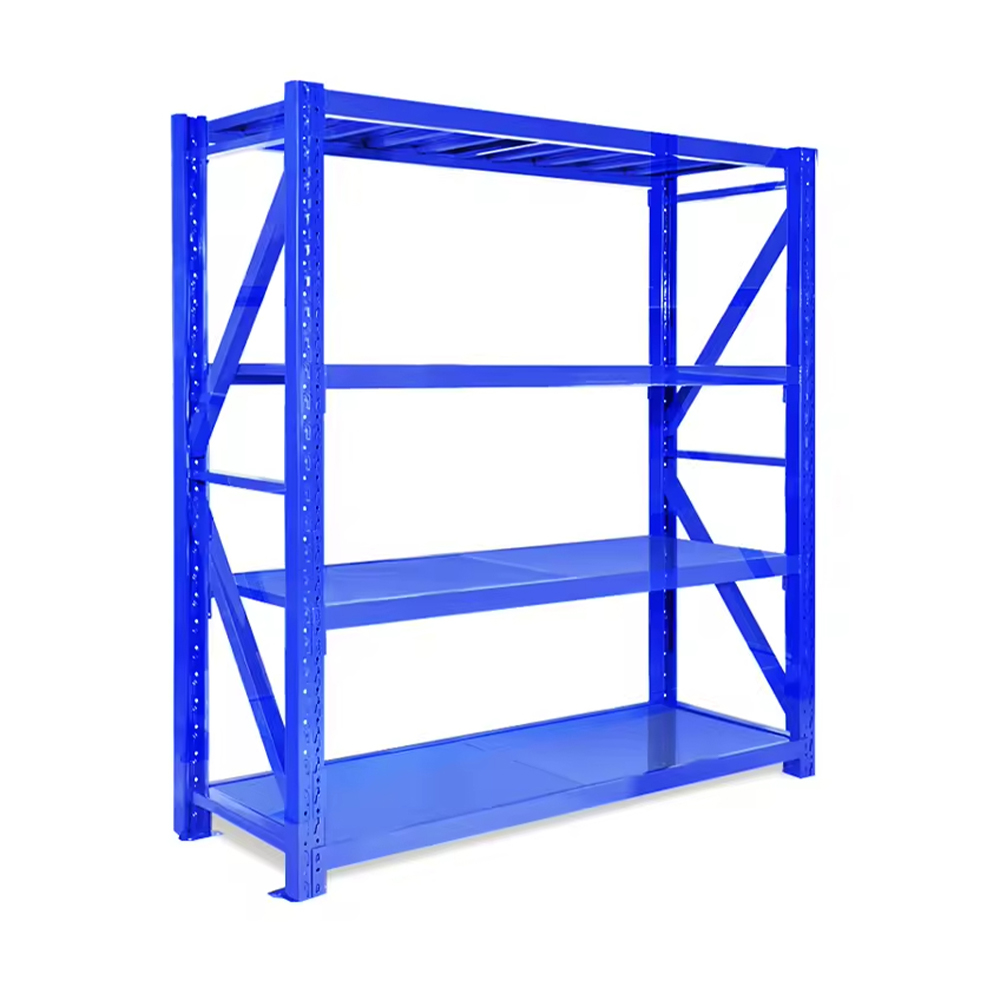
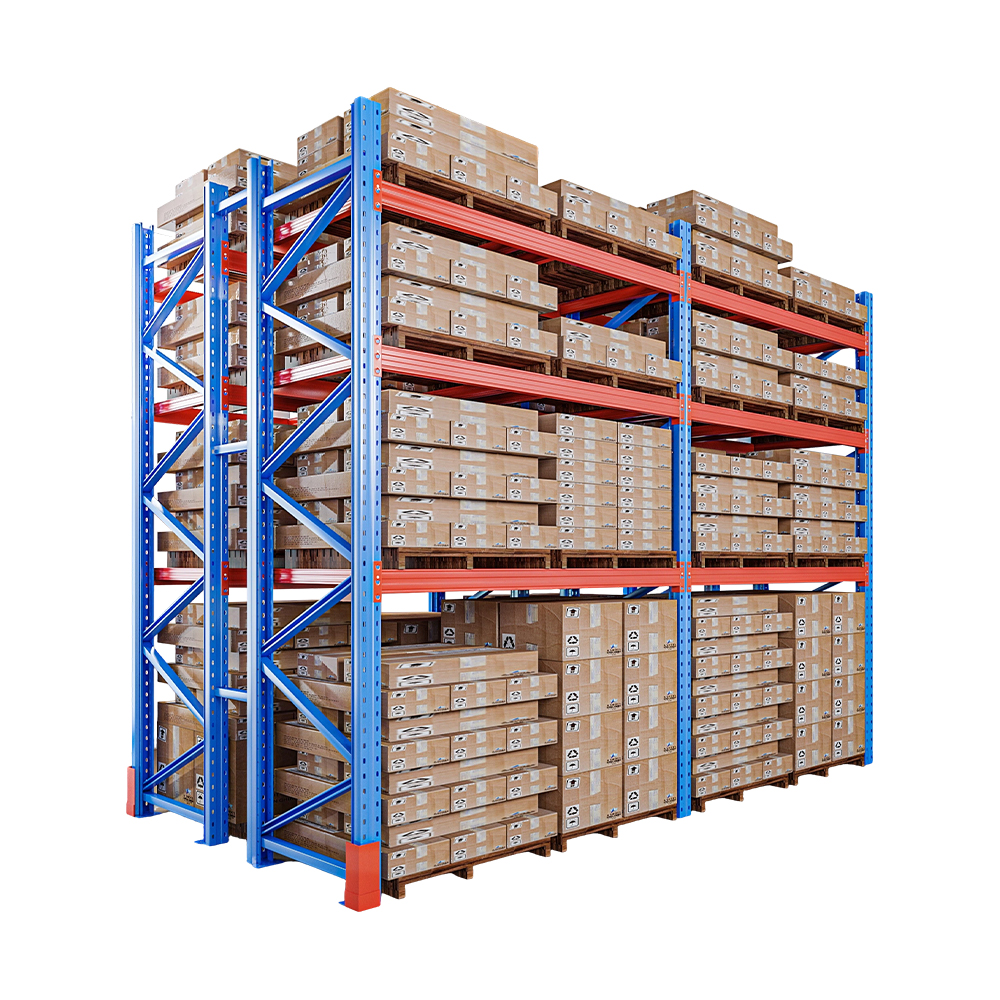
A warehouse rack is a steel framework used to store goods above floor level, and almost every warehouse rack on the market is built to one of three general duty ratings: light, medium, or heavy. The duty rating tells you how much weight a shelf level or beam can safely carry, and it is the single most useful number for narrowing down which product fits a given job: a light duty rack suits small parts and low-volume storage, a medium duty rack suits general retail or e-commerce cartons, and a heavy duty rack, often built as pallet racking, suits palletized bulk goods in a distribution center. Specialized formats such as a clothing rack for apparel storage and stainless steel shelves for clean or regulated environments sit alongside these three core ratings, built for a specific handling need rather than a specific weight class alone.
This guide compares light, medium, and heavy duty warehouse rack options, looks at where clothing racks and stainless steel shelves fit into a broader storage plan, and walks through the practical factors a warehouse manager or facility planner should check before placing an order. A rack manufacturer generally engineers each duty rating around a defined combination of steel gauge, beam profile, and connection hardware, so understanding the duty rating system first makes every other comparison in this guide easier to follow.
Rack Types Covered in This Guide
Light Duty Rack – for small parts, tools, and low-volume SKUs
Medium Duty Rack – for general retail, e-commerce, and light manufacturing loads
Heavy Duty Rack and Pallet Racking – for high-volume, palletized distribution center storage
Clothing Rack – for hanging apparel storage in warehouses and retail backrooms
Stainless Steel Shelves – for food, pharmaceutical, and other clean or corrosion-sensitive environments
Warehouse Rack Duty Ratings at a Glance
The table below compares typical load duty, common construction, and common industries for each rack type discussed in this guide. Actual load capacity always depends on the specific beam profile, upright gauge, and bay width a rack manufacturer uses, so this table should be read as a general planning reference rather than a substitute for a supplier's load-rated drawing.
Table 1. General comparison of warehouse rack duty ratings and specialized shelving formats.
Rack Type
Typical Construction
Common Industries
Light Duty Rack
Lighter gauge steel, boltless shelf panels
Workshops, small parts storage, general warehousing
Relative Load Capacity Across Warehouse Rack Types
The horizontal bar chart below places each rack type on a single relative scale to show how load capacity generally increases from a clothing rack through to a fully rated heavy duty rack or pallet racking system. This is a relative index rather than a specific weight figure, since the exact rated capacity of any warehouse rack depends on the beam, frame, and bay width a manufacturer specifies for that product. Reading the chart helps explain why a facility rarely uses only one rack type, since the items that belong on a clothing rack are a poor fit for a heavy duty rack, and the reverse is equally true. The five categories shown are clothing rack, light duty rack, stainless steel shelves, medium duty rack, and heavy duty rack or pallet racking, ordered from lowest to highest on this relative index. Facility planners generally use a chart like this as an early filter, then confirm the final specification with a rack manufacturer once the general category has been chosen.
Heavy duty rack and pallet racking sit at the top of this index because they are engineered to carry palletized loads stacked across several beam levels, often up to the usable height of a distribution center. Medium duty rack products sit in the middle of the scale, reflecting their common role holding cartons and mixed retail inventory that is heavier than loose parts but lighter than a full pallet. Stainless steel shelves score in the lower-middle range on pure load capacity, since their main design priority is corrosion resistance and a smooth, easily cleaned surface rather than maximum weight per shelf, though heavier-gauge stainless options do exist for specific applications. Light duty rack products score lower still, which fits their typical role holding small parts bins, tools, or archive boxes rather than dense inventory. Clothing racks sit at the bottom of the load capacity index, which is expected since a garment rack is designed around hanging volume and rail length rather than shelf weight. It would be a mistake to read a low position on this chart as a general weakness, since a clothing rack that holds a full rail of hanging apparel is doing exactly what it needs to do, in the same way a stainless steel shelf that resists corrosion in a wash-down environment is succeeding on the criterion that actually matters for that setting. Warehouses handling a mixed product range, such as an apparel distribution center that also ships packaged accessories, commonly use several of these rack types together rather than forcing every item onto a single system. Facility planners should treat this chart as a starting comparison to identify the general category, then confirm bay-level load ratings with a rack manufacturer before finalizing an order. Because duty ratings can vary between manufacturers even within the same general category name, asking for the specific rated capacity per shelf or per beam level is a reasonable step before large purchase decisions. Once the general duty rating has been narrowed down using a comparison like this, the next step is usually matching that rating to the physical layout of the building, including aisle width and ceiling height.
Light Duty Racks for Small Parts and Low-Volume Storage
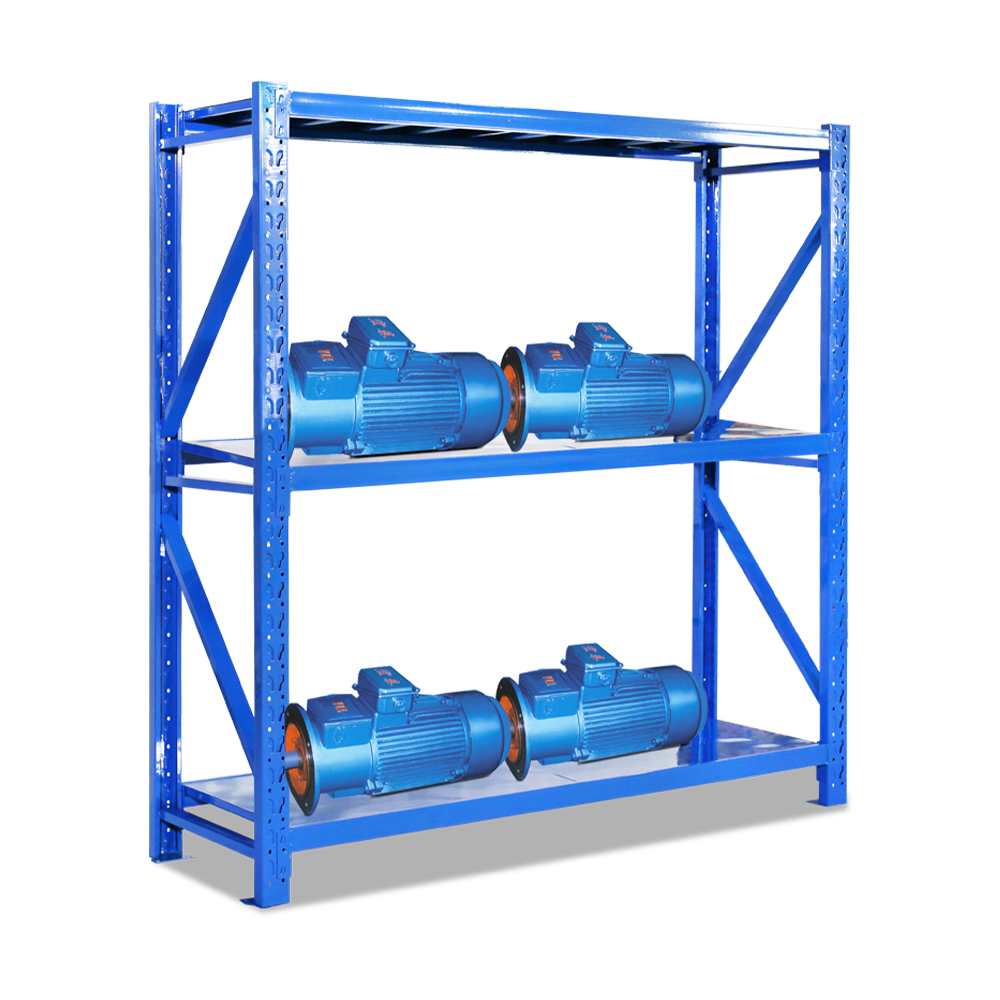
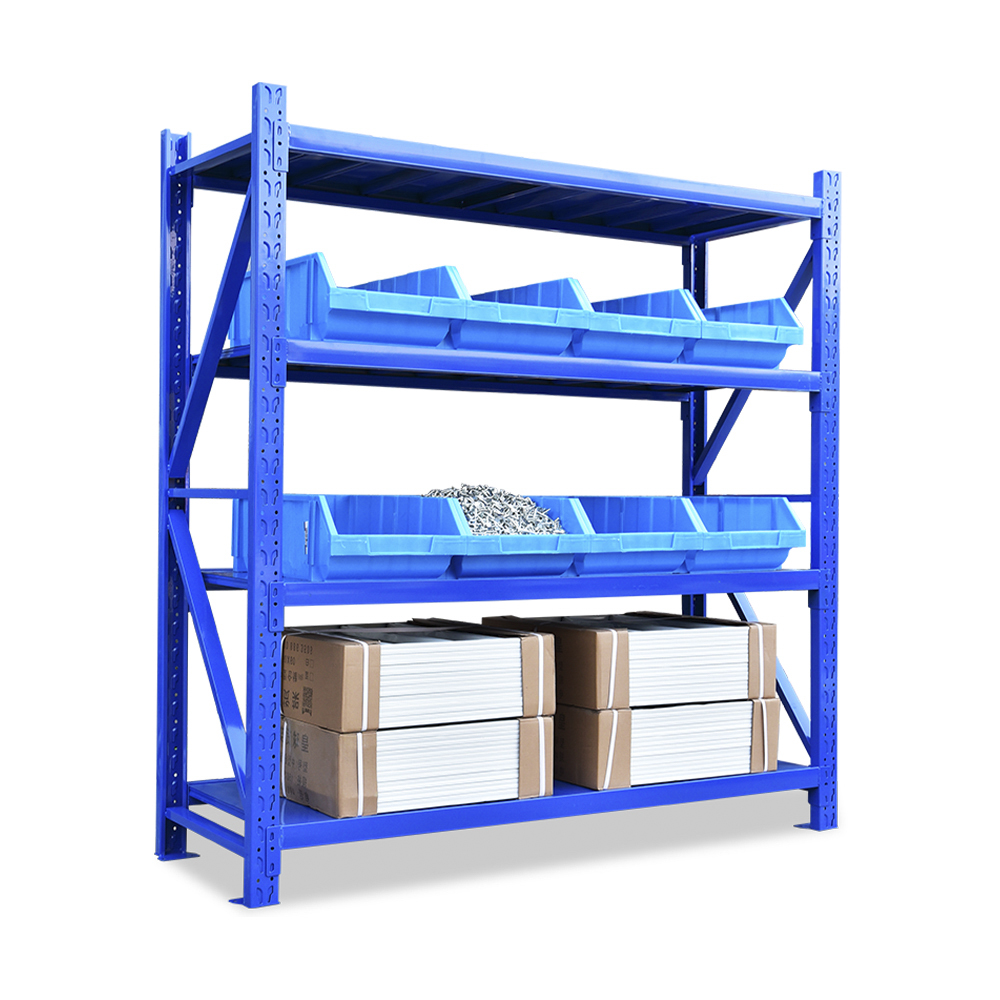
A light duty rack is generally built from a lighter gauge steel frame with boltless shelf panels, designed for items that are bulky in count but light in individual weight, such as small parts bins, hand tools, spare fittings, or archive boxes. Because a light duty rack is easy to assemble and reconfigure without welding, it is a common choice for workshops, maintenance rooms, and general warehousing areas that need flexible storage rather than maximum load capacity. Shelf levels are usually adjustable in height, which allows a facility to fit taller or shorter items on the same frame as inventory changes.
Typical light duty rack applications include small component storage in electronics assembly, spare parts rooms in maintenance departments, and general stockrooms where items are picked frequently by hand rather than by forklift. Because the frame is lighter, a light duty rack is also easier to relocate within a facility as layouts change, which is useful for growing businesses that expect to reorganize storage more than once. When comparing light duty rack options from different suppliers, checking the rated capacity per shelf level, rather than assuming a similar-looking frame carries a similar load, remains a reasonable step before committing to a large order.
Medium Duty Racks for Retail and E-Commerce Fulfillment
A medium duty rack sits between light duty shelving and full pallet racking, generally built with a stronger steel frame and adjustable beam levels sized for cartons, totes, and mixed retail inventory. Medium duty rack systems are widely used in retail warehouses and e-commerce fulfillment centers, where a wide range of stock keeping units needs to be stored at a weight class heavier than small parts but lighter than a full pallet load. This makes a medium duty rack a practical middle ground for businesses whose inventory mix does not justify full pallet racking throughout the entire facility.
Light manufacturing operations also use medium duty rack systems for work-in-progress storage, holding sub-assemblies or components between production stages where a full pallet racking system would be oversized for the load involved. Because e-commerce fulfillment centers often handle a large number of distinct stock keeping units picked individually rather than by the pallet, medium duty rack layouts frequently use narrower, more numerous shelf levels than a comparable heavy duty rack bay, prioritizing pick density and accessibility over maximum tonnage per level.
Heavy Duty Racks and Pallet Racking for High-Volume Distribution
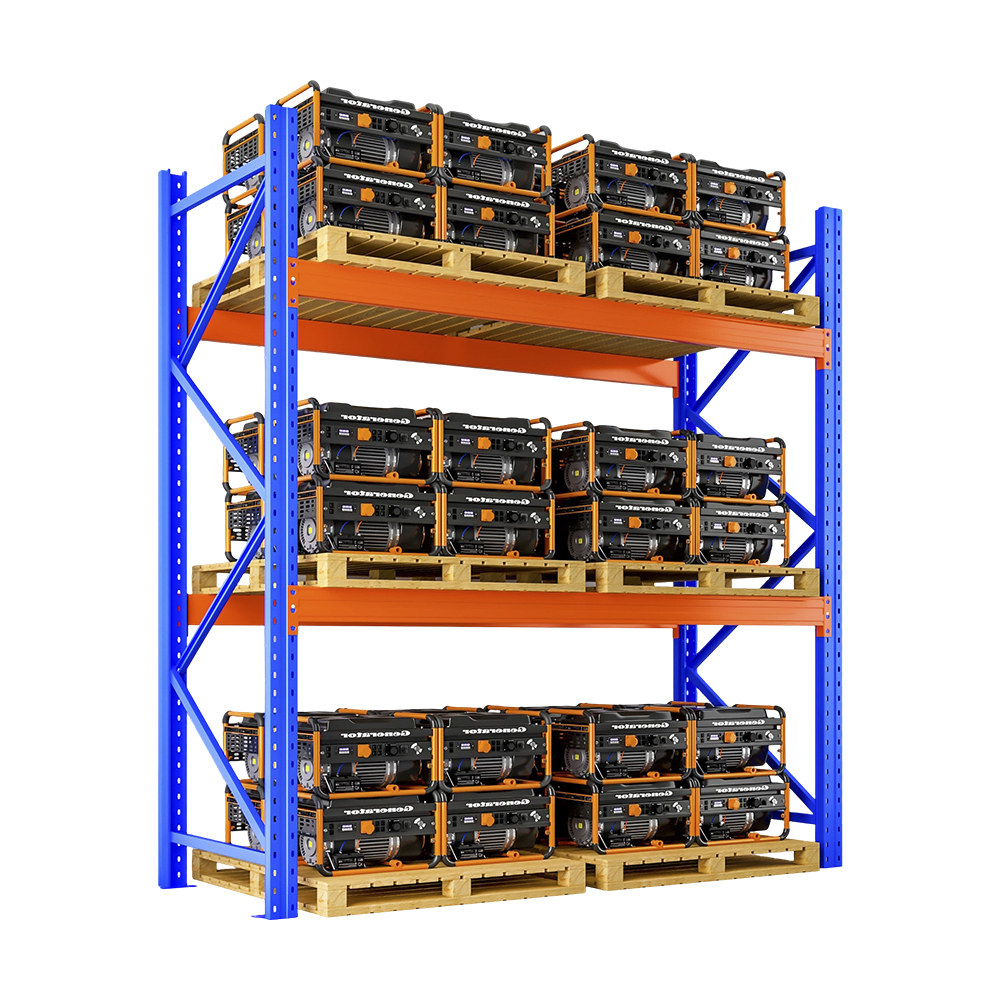
A heavy duty rack, most commonly built as pallet racking, uses thicker gauge upright frames, load beams, and wire mesh or steel decking to carry palletized goods stacked across multiple levels. This is the rack type most closely associated with high-volume distribution centers, cold chain warehouses, and automotive parts storage, where goods arrive and leave the facility on standard pallets handled by forklift or reach truck. A heavy duty rack bay is typically labeled with its rated capacity per level, and operators are expected to keep loads within that rating to avoid beam deflection or frame damage over time.
The isometric diagram above is a simplified structural illustration of a two-level heavy duty rack, showing the upright frame on each side, load beams spanning between the frames at each level, wire decking sitting on top of the beams to support the pallet, and the base plate anchoring the frame to the floor. Real pallet racking installations often include additional levels above what is shown here, along with row spacers and upright protectors, but the core components remain the same regardless of how many levels a specific heavy duty rack bay includes.
Clothing Racks for Apparel Warehousing and Retail Backrooms
A clothing rack is built around a hanging rail rather than a flat shelf, typically consisting of upright posts, a horizontal rail near the top, and sometimes a lower shelf for folded items, shoes, or accessories. Clothing racks are widely used in apparel warehouses, retail backrooms, and garment staging areas, where hanging storage keeps clothing in better condition and easier to inspect than boxed or folded storage would allow. Rail length and post spacing are usually chosen based on typical hanger width and the volume of hanging stock a facility expects to move through a given area.
The isometric diagram above shows the main structural elements of a typical clothing rack: the upright posts, the hanging rail that carries the weight of garments on hangers, a lower shelf for folded stock or accessories, and the base that keeps the unit stable under a fully loaded rail. Double-rail clothing racks, which add a second hanging level below the first, are also common in apparel warehouses that need to maximize hanging capacity within a limited footprint, following the same basic structural principle shown here.
Stainless Steel Shelves for Clean and Regulated Environments
Stainless steel shelves are built from corrosion-resistant stainless steel rather than coated carbon steel, giving them a smooth, easily cleaned surface that holds up under frequent washdown, humidity, or temperature cycling. This makes stainless steel shelves a common choice in food processing plants, pharmaceutical storage, laboratories, and cold storage areas, where sanitation and corrosion resistance matter as much as raw load capacity. In food-contact or food-handling settings, shelving is often expected to meet recognized sanitary design requirements, such as those set out in the NSF/ANSI 2 food equipment standard published by NSF International, which covers materials, surface finish, and construction details for shelves and related equipment used in food handling areas.
Beyond food and pharmaceutical settings, stainless steel shelves are also used in cold chain warehouses and blast freezing areas, where repeated temperature cycling can accelerate corrosion on lower-grade steel over time. Industry market research on cold chain logistics has consistently pointed to strong growth in temperature-controlled storage infrastructure over the coming years, driven by frozen food consumption, grocery e-commerce, and pharmaceutical distribution, which in turn supports steady demand for shelving finishes that can withstand a cold, frequently washed environment. When specifying stainless steel shelves for a regulated environment, confirming the stainless grade, surface finish, and any applicable certification with the manufacturer is generally more useful than assuming that any stainless-finished product will automatically meet a facility's compliance requirements.
How Rack Mix Changes as a Warehouse Scales
The relationship between facility size and rack duty mix is one of the more consistent patterns seen across warehousing operations of different scales. Smaller operations tend to rely more heavily on a light duty rack or medium duty rack for general storage, while larger distribution centers shift toward a heavy duty rack and pallet racking as the dominant format, simply because higher volume favors palletized handling over piece-by-piece storage. The stacked bar chart below illustrates this general pattern across three facility sizes, and the donut chart that follows shows a typical rack duty composition once a facility reaches a larger, multi-zone scale.
Rack Duty Mix by Facility Size
The stacked bar chart below compares three illustrative facility sizes, a small workshop, a mid-size fulfillment center, and a large distribution center, showing how the share of light duty rack, medium duty rack, and heavy duty rack or pallet racking typically shifts as a facility grows. Each bar represents one hundred percent of that facility's general storage rack footprint, divided into the three duty categories. This is a general pattern drawn from how warehousing operations are commonly organized, not a measurement from any single named facility. A small workshop generally leans on a light duty rack for most of its storage, since volumes are lower and items are picked by hand rather than palletized. As volume grows through a mid-size fulfillment center and into a large distribution center, the share held by heavy duty rack and pallet racking increases steadily, reflecting the shift toward palletized inbound and outbound handling at higher throughput.
Light Duty Rack
Medium Duty Rack
Heavy Duty Rack / Pallet Racking
In the small workshop bar, a light duty rack accounts for roughly sixty percent of general storage, with medium duty rack and heavy duty rack making up smaller shares, which lines up with a setting where most items are picked by hand and few goods arrive on full pallets. Moving to the mid-size fulfillment center bar, the light duty rack share drops while medium duty rack becomes the largest single category, reflecting a facility built mainly around carton and tote picking for e-commerce or retail orders rather than either very small parts or full pallet loads. The large distribution center bar shows heavy duty rack and pallet racking as the dominant category at roughly two-thirds of the footprint, with medium duty rack holding a meaningful secondary share and light duty rack reduced to a small fraction reserved for slow-moving or oddly sized items. This progression is not a fixed rule that every facility must follow, since product type matters as much as facility size, but it does reflect a pattern commonly observed as throughput increases and palletized handling becomes more efficient than piece picking. A facility evaluating its own rack mix can use this chart as a rough benchmark, checking whether its current split looks unusually skewed toward one duty rating given its actual size and order profile. Businesses growing quickly, such as an expanding e-commerce operation, often find that their rack mix needs to shift within a fairly short period, moving from a mostly light and medium duty rack layout toward a growing share of heavy duty rack and pallet racking as volumes increase. Planning for this shift in advance, rather than reacting to it after storage runs out, generally makes it easier to negotiate lead times and floor space with a rack manufacturer. The chart also does not include clothing racks or stainless steel shelves, since these specialized formats are typically sized to a specific product category rather than scaling directly with overall facility size in the same way general storage racks do.
Typical Rack Duty Composition in a Multi-Zone Distribution Center
The donut chart below shows a typical rack duty composition once a facility has grown into a larger, multi-zone distribution center that also handles some specialized inventory, such as apparel or cold storage goods. Four segments are shown: heavy duty rack and pallet racking, medium duty rack, light duty rack, and a combined specialty segment covering clothing racks and stainless steel shelves together. This composition reflects a facility that has scaled up its bulk storage while still maintaining smaller specialized zones for particular product types, rather than a facility using only one rack format throughout. Because a multi-zone facility often ships a wider variety of goods than a single-purpose warehouse, its rack duty composition tends to be more varied than the simple progression shown in the stacked bar chart above. Viewing this composition alongside the facility-size comparison helps illustrate that even a large distribution center dominated by heavy duty rack and pallet racking will usually still carry a meaningful share of medium and light duty rack, plus room for specialized formats where the product mix calls for them.
Heavy Duty Rack / Pallet Racking – approximately 50 percent
Medium Duty Rack – approximately 25 percent
Light Duty Rack – approximately 15 percent
Clothing Racks and Stainless Steel Shelves combined – approximately 10 percent
Heavy duty rack and pallet racking make up half of this illustrative composition, which fits the earlier point that palletized storage tends to dominate floor area once a facility reaches distribution center scale. Medium duty rack holds the second largest share, generally covering carton-level picking zones that support faster order fulfillment than a full pallet system would allow. Light duty rack occupies a smaller but still notable share, typically reserved for small parts, spare fittings, or slow-moving items that do not justify a heavier format. The combined specialty segment, covering clothing racks and stainless steel shelves, is the smallest share shown here, which reflects that these formats usually serve a specific product category rather than general bulk storage, even though they remain essential wherever that category, such as apparel or temperature-sensitive goods, makes up part of the facility's business. A facility manager reviewing this composition against their own operation can use it as a sense check, for example noting that a distribution center with an unusually small heavy duty rack share relative to its throughput may be leaving pallet storage capacity underused elsewhere in the building. Because this chart represents one illustrative composition rather than a fixed target, the right mix for any specific facility should ultimately be based on its own product range, order profile, and building constraints, worked out with a rack manufacturer or supplier familiar with load-rated layout design.
Comparing Duty Ratings Across Key Selection Criteria
The radar chart below compares light duty rack, medium duty rack, and heavy duty rack or pallet racking across five practical selection criteria: load capacity, space efficiency, installation speed, suitability for high picking frequency, and general corrosion resistance. Each axis uses a simple one-to-five scale, with five representing the strongest general performance among the three duty ratings compared here, not an absolute or universal rating. This comparison is meant to support the earlier duty rating discussion by showing where each rack type tends to be strongest and where it tends to trade off against another priority. Because no single rack type is engineered to lead on every criterion at once, the three shapes on this chart are expected to overlap rather than one simply appearing larger overall. Reviewing this chart alongside the facility-size patterns discussed earlier can help confirm whether a planned rack mix matches the operational priorities that matter most for a specific warehouse.
Light Duty Rack
Medium Duty Rack
Heavy Duty Rack / Pallet Racking
Light duty rack scores highest on installation speed and picking frequency fit in this comparison, which reflects that a lighter, boltless frame is usually quicker to assemble and better suited to frequent hand picking than a heavier system built for pallet loads. Medium duty rack sits in the middle across most criteria, which fits its role as a practical general-purpose option for retail and e-commerce fulfillment that does not need to lead on any single factor. Heavy duty rack and pallet racking score highest on load capacity and space efficiency, consistent with the earlier discussion of how palletized storage maximizes vertical stacking within a distribution center, but this system scores lowest on installation speed, since a full pallet racking layout typically requires more planning, heavier equipment, and more careful floor anchoring than a light duty rack. None of the three duty ratings scores highest across all five criteria, reinforcing the point made earlier that duty rating selection is about matching priorities to the specific storage task rather than finding one universally superior product. A workshop or maintenance area prioritizing quick reconfiguration and frequent hand picking will generally lean toward a light duty rack despite its lower load capacity score. A distribution center prioritizing maximum palletized storage per square meter will generally accept the slower installation timeline that comes with a heavy duty rack or pallet racking system. Corrosion resistance is shown as roughly comparable across the three general duty ratings in this chart, since standard carbon steel construction with a powder coat or galvanized finish is common across all three, whereas stainless steel shelves, discussed separately in this guide, are the format to consider specifically when corrosion resistance in a washdown or high-humidity environment is the dominant requirement. As with the earlier charts in this guide, these scores are illustrative comparisons intended to support an initial decision rather than measured data from a specific installation. Once a facility has used this comparison to identify a likely duty rating, confirming exact load ratings and dimensions with a rack manufacturer remains the next practical step before finalizing an order.
Industry Trends Shaping Demand for Warehouse Racks
Industry market research covering both general warehouse racking and the cold chain sector points to continued growth in demand for storage infrastructure over the coming years, generally citing e-commerce order fulfillment, cold chain expansion, and pharmaceutical distribution as recurring drivers, though specific market size figures vary between research providers. Cold chain market research in particular has consistently described strong growth in temperature-controlled storage capacity, driven by frozen food consumption, grocery e-commerce, and pharmaceutical and biologic distribution, which supports steady demand for both heavy duty rack systems rated for cold environments and stainless steel shelves suited to repeated washdown and temperature cycling.
Growth in online apparel retail has also supported demand for clothing racks in warehousing settings, as more apparel businesses operate dedicated fulfillment or return-processing facilities rather than relying solely on store backrooms, and hanging storage remains a practical way to keep garments presentable through multiple handling steps. At the same time, e-commerce fulfillment centers handling a wide range of stock keeping units have driven continued interest in medium duty rack systems designed around pick density rather than pure pallet storage. Rising industrial land and construction costs in many markets have encouraged facilities to make more efficient use of existing floor area, which supports demand for well-organized duty-rated racking across light, medium, and heavy categories rather than informal floor storage. Regional patterns generally show faster growth in parts of Asia-Pacific tied to expanding manufacturing, retail, and cold chain infrastructure, alongside steady replacement and upgrade demand in more established markets. None of these drivers guarantees uniform growth in every segment, and a business planning a new rack purchase should weigh its own throughput and inventory data more heavily than any single industry-wide trend, but the consistent direction across independent research, growth in e-commerce, cold chain expansion, and rising land costs, provides reasonable general context for continued investment in light duty rack, medium duty rack, heavy duty rack, clothing rack, and stainless steel shelf systems over the next several years.
Manufacturing Quality, Safety, and Working With a Rack Manufacturer
Regardless of duty rating, a warehouse rack is a structural product, and its safe working load depends on steel grade, beam and frame design, connection quality, and correct installation rather than on appearance alone. Recognized industry design and installation guidance for steel storage racks, such as that published by the Rack Manufacturers Institute in North America, gives buyers a general benchmark to ask a rack manufacturer about when comparing light duty rack, medium duty rack, or heavy duty rack products, and shelving intended for food-contact environments can also be checked against standards such as NSF/ANSI 2 for food equipment. Production quality factors such as steel gauge consistency, weld or connection quality, and corrosion protection through powder coating, galvanizing, or stainless steel construction all influence how consistently a rack holds its rated capacity over time.
King Global Shelf offers a range of warehouse racking solutions designed to support storage capacity, inventory efficiency, and the varied needs of logistics, manufacturing, and distribution facilities. The core product line includes light duty racks for small parts and low-volume storage in general warehouses and workshops, medium duty racks for mid-weight inventory used in retail warehouses, e-commerce fulfillment centers, and light manufacturing, and heavy duty and pallet racking systems built for palletized goods in high-volume distribution centers, cold chain warehouses, and automotive parts storage. The company also produces custom and specialized racks, including clothing racks for apparel warehouses, tire racks, stainless steel racks for clean environments, and cold-resistant racks for low-temperature storage. Quality control procedures, load testing, and corrosion-resistant finishes are applied across the product line to support durability and operational safety, alongside consultation, layout design, and installation support intended to match each project to its specific storage requirements.
When comparing rack manufacturers, it is generally useful to ask how load ratings for each duty category were determined, what documentation is provided for installation and periodic inspection, and how corrosion protection is applied for the specific environment a rack will be used in, whether that is a dry general warehouse, a cold chain facility, or a food-contact area requiring stainless steel construction.
Frequently Asked Questions About Warehouse Racks and Shelving
Q1: What is the main difference between a light duty rack, a medium duty rack, and a heavy duty rack?
A1: The main difference is the rated load capacity and construction gauge, with a light duty rack built for small parts and low-volume items, a medium duty rack built for cartons and mixed retail inventory, and a heavy duty rack, often configured as pallet racking, built for palletized bulk goods.
Q2: When should a business choose pallet racking instead of a general heavy duty rack layout?
A2: Pallet racking is generally chosen when goods are handled on standard pallets by forklift or reach truck and need to be stacked across several beam levels, which is common in distribution centers, cold chain warehouses, and automotive parts storage.
Q3: What makes a clothing rack different from standard shelving?
A3: A clothing rack is built around a hanging rail rather than a flat shelf, sized for hangers and garment length rather than shelf load, and is generally used in apparel warehouses and retail backrooms where hanging storage helps keep clothing in better condition.
Q4: Where are stainless steel shelves typically required rather than standard coated shelving?
A4: Stainless steel shelves are typically specified for food processing, pharmaceutical, laboratory, and cold storage environments where corrosion resistance, frequent washdown, and compliance with recognized sanitary standards such as NSF/ANSI 2 are important.
Q5: Can a single warehouse use more than one warehouse rack duty rating at the same time?
A5: Yes, most multi-zone facilities combine several duty ratings and formats, such as heavy duty rack or pallet racking for bulk storage, medium duty rack for carton picking, light duty rack for small parts, and clothing racks or stainless steel shelves for specific product categories.
Q6: What should a business confirm with a rack manufacturer before placing a large order?
A6: It is generally worth confirming the rated load capacity for the intended duty category, the steel gauge and corrosion protection used, how ratings relate to recognized racking design guidance, and what installation and inspection documentation the manufacturer provides.
·Medium-Duty High Load-Bearing Storage Rack This storage rack boasts a robust load capacity of 200-500kg per layer, making it ideal for storing medium-heavy items in home, office and small warehouse settings.The multi-bent beam design significantly improves the structural strength, ensuring exceptional stability and load-bearing performance even when fully loaded.·Reinforced Steel Structure for Enhanced Durability Constructed from high-quality reinforced steel shelf panels, this rack offers superior durability and resistance to bending and deformation.The one-piece shelf edge design provides added safety, preventing items from falling off the shelves and ensuring safe daily use.·Stable & Anti-Wobble Engineering Design The reinforced uprights and multi-bent beams form a solid triangular support structure, effectively preventing wobbling and ensuring overall stability.This professional engineering design ensures that the rack remains stable even when storing heavy items on the top layers, eliminating safety hazards.·Long-Lasting Anti-Corrosion Finish The entire rack is treated with a premium powder coating finish, which provides excellent rust and corrosion resistance, extending the service life of the rack.This finish also gives the rack a sleek and professional appearance, making it suitable for both home and commercial environments.·Easy to Assemble & Maintain This rack comes with all necessary hardware and a detailed installation manual, making assembly quick and hassle-free.The smooth surface is easy to clean and maintain, simply wipe with a damp cloth to remove dust and dirt, keeping the rack looking new for years.
【Maximize Warehouse Storage Efficiency】This pallet storage rack allows you to fully utilize your warehouse's vertical space, significantly increasing your storage capacity and improving overall warehouse efficiency.It is the perfect solution for storing bulk palletized inventory, allowing you to organize your goods systematically and access them quickly and easily when needed.【Customizable to Your Warehouse Layout】The modular design of this rack allows you to customize the layout to fit your warehouse space, whether you need a single row, multiple rows, or a complete warehouse storage system.You can easily adjust the height, width and depth of the racks to fit your specific warehouse dimensions and storage needs, creating a truly customized storage solution.【Improve Inventory Management】By organizing your palletized goods on these racks, you can easily categorize and track your inventory, making stocktaking and inventory management much simpler and more efficient.This helps reduce the risk of lost or misplaced goods, improves order fulfillment speed, and ensures that your warehouse operations run smoothly.【Safe & Compliant Industrial Storage】This rack is designed and manufactured to meet all industrial safety standards, ensuring that your warehouse storage system is safe and compliant with relevant regulations.【Cost-Effective Warehouse Storage Solution】This industrial-grade pallet rack offers exceptional performance and durability at a competitive price, making it a cost-effective alternative to more expensive custom warehouse storage systems.It is built to last for many years, providing a long-term return on your investment and reducing your overall warehouse storage costs over time.
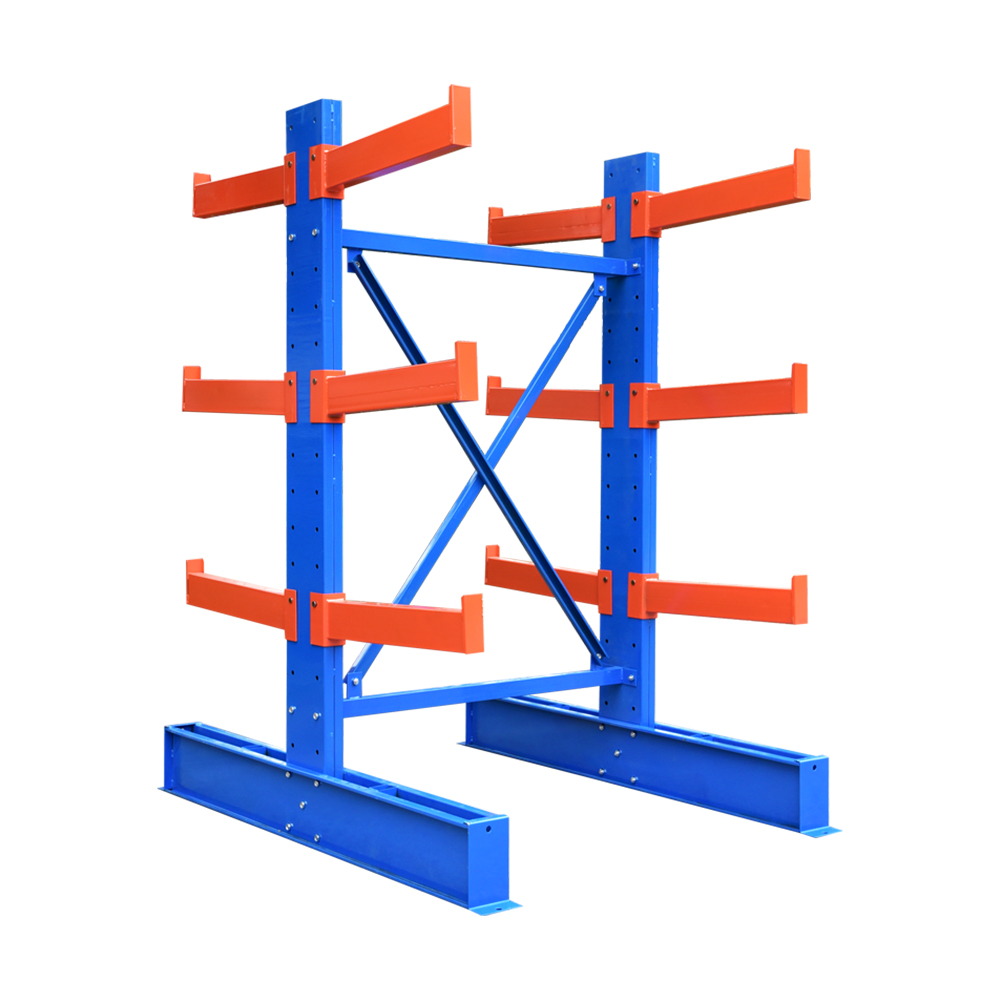
【Ideal Storage Solution for Long & Irregular Goods】If you need to store long, oversized or irregularly shaped items that don't fit on standard pallet racks, this specialized storage rack is the perfect solution.It is designed specifically to accommodate items such as pipes, lumber, steel bars, carpets, rolls of fabric, construction materials and other long goods, keeping them organized, secure and easily accessible.【Improve Material Handling Efficiency】The wide-load accessible design of this rack makes it easy to load and unload long items using standard warehouse equipment, such as forklifts and pallet jacks.This reduces the time and labor required for material handling, improves operational efficiency, and minimizes the risk of damage to your goods during loading and unloading.【Maximize Your Warehouse Storage Space】This rack allows you to make the most of your warehouse's vertical space, storing long items vertically or horizontally to maximize your storage capacity.It helps you keep your warehouse organized and clutter-free, reducing wasted floor space and improving overall space utilization in your facility.【Safe & Secure Storage for Valuable Goods】The reinforced steel structure and stable design ensure that your long and valuable goods are stored safely and securely, with minimal risk of falling, bending or damage.This gives you peace of mind, knowing that your expensive materials and equipment are well-protected and stored in a safe, organized manner.【Versatile for Multiple Industrial Applications】This rack can be used in a wide variety of industrial settings, including warehouses, factories, construction sites, lumber yards, plumbing supply companies and more.Its versatile design and customizable configuration make it suitable for almost any application that requires the storage of long or irregularly shaped items.
【Heavy-Duty High-Capacity Industrial Storage Rack】This industrial-grade storage rack is engineered for heavy-duty use, with a load capacity of over 500kg per layer, making it ideal for warehouse, factory and industrial storage applications.The multi-folded beam design significantly increases the load capacity and structural strength, ensuring exceptional stability even when storing the heaviest industrial items.【Reinforced Upright Design for Quick Installation】The upright design enables quick and easy boltless installation, saving you valuable time and labor during setup.This innovative design also provides superior structural support, ensuring that the rack remains stable and secure even when fully loaded with heavy goods.【Industrial-Grade Steel Construction】Constructed from high-quality cold-rolled steel, this rack offers exceptional durability, bending resistance and load-bearing performance, meeting the rigorous demands of industrial use.The reinforced structure is designed to withstand long-term heavy use, making it a reliable storage solution for industrial environments.【Boltless Modular Design for Flexibility】The boltless modular design allows for easy assembly and disassembly, as well as flexible reconfiguration to adapt to changing storage needs.You can easily adjust the shelf height, add or remove shelves, or even expand the rack as your storage requirements grow, without the need for complicated tools or professional help.【Durable Anti-Corrosion Industrial Finish】The entire rack is treated with powder coating finish, which provides excellent rust, corrosion and scratch resistance, making it suitable for harsh industrial environments.This finish also gives the rack a professional and rugged appearance, perfect for warehouse and factory settings.
·Light-Duty High-Capacity Storage Rack This storage rack is engineered for light-duty daily use, with a load capacity of up to 200kg per layer to meet daily storage needs.The butterfly hole upright design enables tool-free installation, while the height-adjustable shelves allow flexible customization to fit items of different sizes.·Premium Anti-Rust Construction for Long-Term Use Made of high-quality steel with a professional anti-rust coating, this rack offers exceptional durability and corrosion resistance for long-term daily use.The reinforced structure ensures excellent stability, preventing wobbling even when fully loaded, making it a reliable storage solution for daily life.·Tool-Free Quick Assembly Design Featuring an innovative butterfly hole upright structure, this rack can be easily assembled without any complicated tools, saving your time and effort.The detailed installation manual is included, allowing one person to complete the assembly in a short time without professional help.·Flexible Adjustable Layer Height The shelves can be freely adjusted to different heights, making it easy to store items of various sizes, from small boxes to large luggage and home appliances.This flexible design ensures that you can make the most of the vertical space, adapting to your changing storage needs at any time.·Multi-Scene Adaptable Storage Solution This versatile storage rack is perfect for home, office, retail store and light industrial use, meeting all your daily storage needs.Whether you need to organize books in the study, sundries in the living room, goods in the retail store or tools in the workshop, this rack can handle it all.
【Heavy-Duty Pallet Storage Rack for Warehouse Use】This industrial-grade pallet storage rack is specifically engineered for warehouse and factory use, designed to support heavy pallets and bulk inventory with exceptional stability and load-bearing capacity.The reinforced beams and uprights provide superior structural support, making it ideal for storing heavy palletized goods, industrial equipment and bulk materials.【Flexible Adjustable Beam Design】The beam levels can be easily adjusted to fit different pallet sizes and storage needs, allowing you to customize the rack to accommodate a wide range of goods.This flexible design ensures that you can make the most of your warehouse space, adapting to your changing inventory and storage requirements at any time.【High-Capacity Load-Bearing Performance】This rack is built to handle heavy loads, with each beam capable of supporting the weight of fully loaded pallets, making it suitable for the most demanding industrial storage applications.The reinforced steel construction ensures that the rack remains stable and secure, even when storing the heaviest items, eliminating the risk of collapse or damage.【Modular Bolted Design for Stability】The modular bolted design provides exceptional structural rigidity and stability, ensuring that the rack remains solid and wobble-free even when fully loaded.This professional design is widely used in industrial warehouses around the world, meeting all relevant safety standards and providing a reliable long-term storage solution.【Durable Industrial Finish for Long-Term Use】The entire rack is treated with a powder coating finish, which provides excellent rust, corrosion and scratch resistance, making it suitable for harsh industrial environments.This finish extends the service life of the rack, ensuring that it remains in good condition for many years, even with heavy daily use.



 English
  Español
  русский
  Français
  한국어
한국어  عربى
عربى  ไทย
ไทย  Deutsch
  Bahasa Melayu
  Português
  Polskie