Pull a bicycle down from the wall of your garage and you learn everything you need to know about a hanging rack garage setup in about two seconds. If the rail flexes in the middle, if the bracket creaks, or if the whole assembly shifts a few millimetres every time you load it, the problem is almost never the steel itself. The problem is what the rack is fixed to, how far apart the fixings are, and how much weight has quietly been added over the years.
Here is the conclusion first. A hanging rack that survives a garage depends on three variables working together: the substrate the anchors bite into, the unsupported span between two fixing points, and the real gauge of the steel carrying the load. Get one of those three wrong and the other two cannot compensate. Most complaints about garage hanging racks failing trace back to anchoring and span, not to the metal.
This guide unpacks those three variables in practical terms. It covers what load figures actually mean, which finishes survive a garage that swings between freezing and humid, how to plan the layout around door swings and car clearance, and what to ask before buying one unit or a container load.
The limiting factor in a garage hanging rack is rarely the steel. It is the anchor substrate, the fixing span and the real weight being hung, matched to each other.
Why a Garage Is the Hardest Room in the House for Storage
A garage is not a climate-controlled storeroom. It is an unconditioned box that experiences humidity swings, road salt dust, sawdust from weekend projects, and temperatures that can move forty degrees between a January night and a July afternoon. Every material in a hanging rack is working against that environment.
The load profile is unusual too. Garages tend to hold the items that are awkward, heavy and seasonal. Ladders, spare tyres, roof boxes, kayaks, garden tools, bags of cement, bicycles that weigh anywhere from eight to twenty-five kilograms each. None of these are neatly distributed. They get hung on whatever hook is free, at whatever height is convenient, often with one hand while the other hand holds a coffee.
There is also a maintenance problem that does not exist in a warehouse. Nobody inspects a home garage rack on a schedule. A warehouse racking system gets a formal inspection and a documented load sign. A garage rail gets checked when something falls off it. That difference is why generous safety margins matter so much more at home than the raw load number suggests.
One more factor is worth naming. Garage walls are often finished differently from the rest of the house. A builder may have clad a concrete block wall with plasterboard on battens, or left bare block, or used a single layer of board over timber studs at wide centres. The rack does not care what the surface looks like. It only cares what is behind it.
A garage combines humidity swings, unchecked overload and walls that are often finished differently from the rest of the house, which is why an unverified anchor is the single most common point of failure.
What Load Ratings Actually Mean on a Hanging Rack
A number printed on a product page is a starting point, not a promise about your garage. Understanding what sits behind that number is the difference between a rack that lasts fifteen years and one that sags in three.
Static load versus dynamic load
A static load rating describes weight sitting still. A dynamic load rating describes weight that arrives with force, such as a bicycle being lifted onto a hook and dropped the last few centimetres. Dynamic loads can briefly exceed the static weight by a factor of two or more. A rack rated at one hundred kilograms per level may see a momentary spike well above that every time somebody hangs a ladder on it in a hurry.
Uniformly distributed versus point load
Uniformly distributed load means weight spread evenly across a beam. Point load means everything concentrated in one spot, such as a single heavy toolbox hung at the midpoint of a rail. A rail that handles two hundred kilograms spread across four metres may struggle with forty kilograms concentrated halfway between two supports. In garages, point loads are the norm, not the exception.
The span effect
Deflection rises steeply as the distance between supports grows. Doubling the unsupported span does not double the sag, it multiplies it several times over. This is why a long rail with fixings only at the two ends will bow in the middle no matter how thick the steel is. Adding intermediate brackets is usually a far more effective fix than buying a heavier rail.
Where the common categories sit
The chart below compares the general load range you will encounter across the four storage categories most often used in a garage hanging setup. These are broad industry reference bands rather than a specification for any particular model, and they should always be checked against the manufacturer's own documentation.
Indicative safe working load per level or per arm (kg)
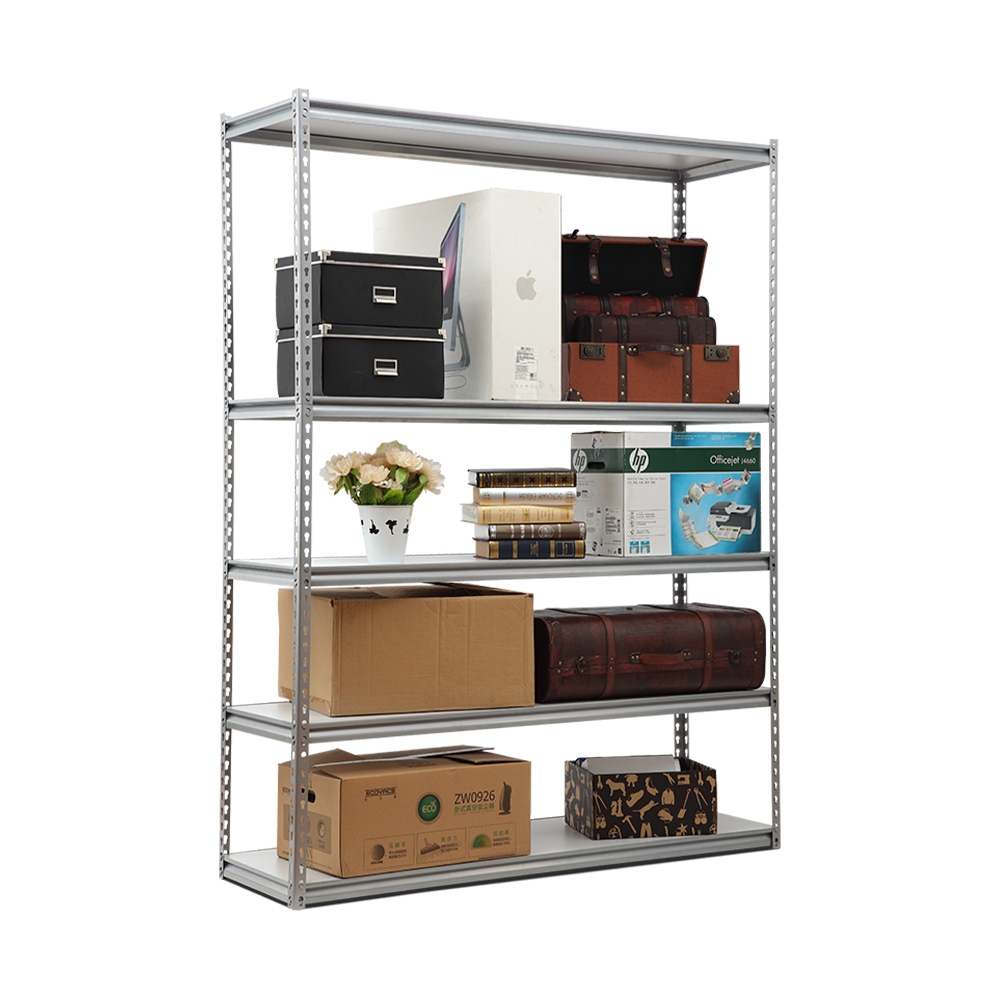
Light-duty steel shelving
50-100
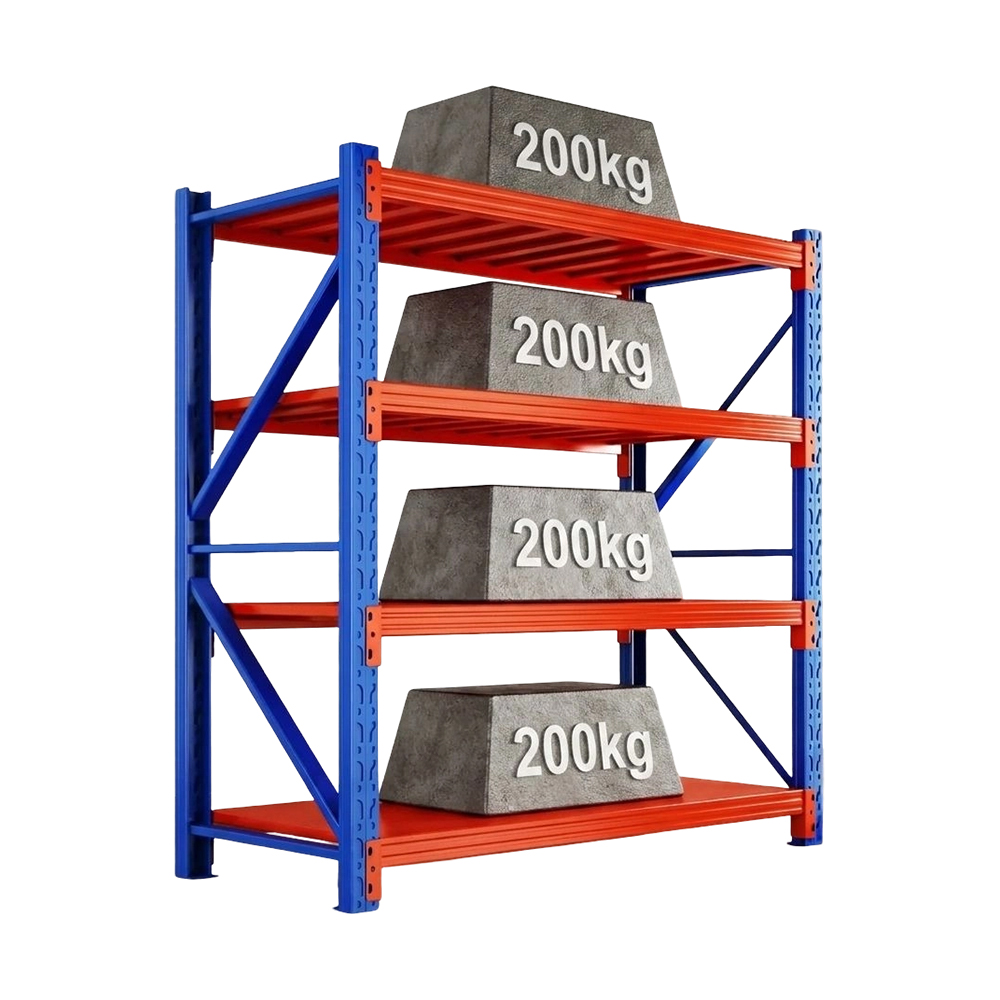
Medium-duty steel racking
150-300
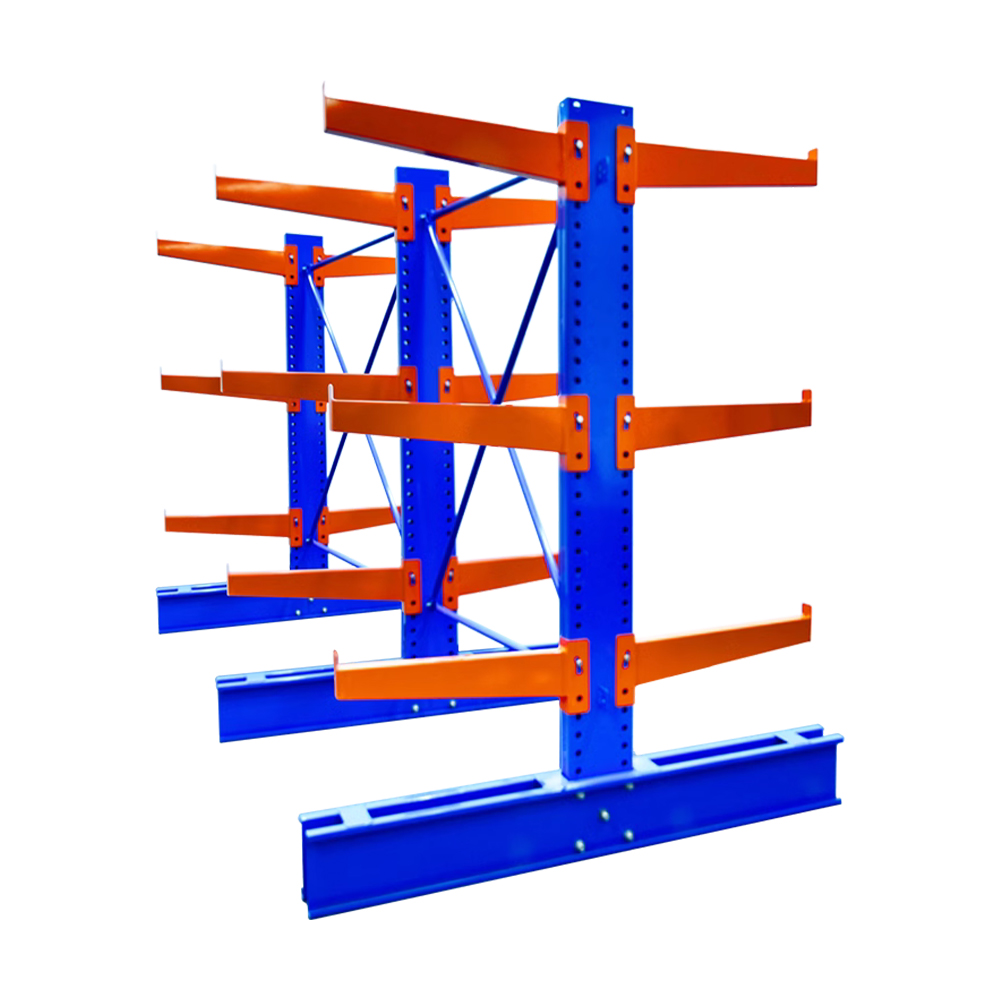
Cantilever racking (per arm)
300-800
Heavy-duty industrial racking
800-1500
The spread between light-duty and heavy-duty is roughly an order of magnitude, and that gap explains most mismatches. Someone buys a light-duty adjustable shelf because it looks tidy, then hangs winter tyres on it. Someone else over-specifies a heavy-duty pallet rack for a single bicycle, and then struggles with the weight, the bolt-together assembly and the floor space it consumes.
For a domestic garage, the practical middle ground tends to be medium-duty racking combined with a properly braced rail. It carries enough for a full set of stored wheels, tool cases and garden equipment without needing a forklift to move it during a spring clean. Where the load is long and awkward, such as timber, pipe or ladders, a cantilever arm holds it better than a flat shelf because there is nothing in the way when you slide the load on and off.
If you want to go deeper into how duty classes are defined and tested, we cover the differences between light, medium and heavy classes in our warehouse rack duty ratings guide. The principles carry over directly to a domestic garage, because the physics does not change with the size of the building.
A published load figure assumes evenly distributed weight and a tested span. Concentrated garage loads and long unsupported runs both reduce the real capacity well below that number.
Steel, Coating and Why Cheap Racks Fail in Cold Garages
Two racks can look identical in a photograph and behave completely differently after two winters. The difference sits in steel grade, sheet thickness, weld quality and surface treatment.
Thickness versus gauge claims
Nominal thickness and actual thickness are not always the same thing. A rail described as one point five millimetres may measure closer to one point one once the coating is stripped. On a short span this makes almost no difference. On a two-metre span it changes how quickly the beam takes a permanent set. When comparing quotations, ask for the measured steel thickness of the load-bearing member, not the finished profile.
Coating performance in an unheated space
Powder coating gives a clean, uniform finish and works well indoors. It is also a barrier coating, which means any scratch that reaches bare steel becomes a starting point for rust. In a garage, scratches are inevitable, because you are sliding ladders and bicycle frames across the surface. A zinc-based or galvanised treatment sacrifices itself instead of the steel, which is why it holds up better in damp or coastal environments.
For garages near the coast, or garages that double as a laundry drying space, corrosion protection is not a cosmetic concern. It is the difference between a rack that is still structurally sound in ten years and one where the welds have started to weep rust stains onto the wall.
Welds and joints
A rack fails at its joints far more often than in the middle of a beam. Look at how the bracket meets the upright and how the rail end is closed off. Open tube ends let moisture in and let it sit there. Sealed or capped ends are a small detail with a long-term payoff.
Material choice by zone
Not every part of a garage needs the same specification. A dry internal wall away from the door can carry a powder-coated adjustable shelf without any trouble. The wall next to the garage door, which gets rain blow-in and road spray, benefits from stainless or galvanised components. Splitting a garage into a dry zone and a wet zone and specifying accordingly usually costs less than upgrading everything.
Match the coating to the zone: barrier coatings are fine on dry internal walls, but galvanised or stainless components last far longer near a garage door exposed to rain and road spray.
Wall-Mounted, Ceiling-Mounted or Freestanding: Which Fits Your Garage
The mounting method decides how much floor you keep, how much headroom you preserve and how difficult the installation will be. All three options work; they simply suit different garages.
Comparison of the three main hanging and storage mounting approaches for a domestic garage.
| Approach |
Best suited to |
Key advantage |
Main limitation |
| Wall-mounted rail and brackets |
Solid masonry or well-framed walls, tight floor space |
Keeps the floor completely clear and puts long items at eye level |
Depends entirely on wall strength and correct anchoring |
| Ceiling-mounted hanging system |
High ceilings, storage of flat or long items above head height |
Uses wasted overhead volume, leaves walls free for shelving |
Requires joist access and enough clearance above the car roof |
| Freestanding rack or shelving unit |
Rented properties, weak walls, garages that may be reconfigured |
No structural fixing required, easy to move or resell |
Consumes floor area and can be tipped if not loaded from the bottom up |
In practice, most well-organised garages use a combination. A wall rail above the workbench for hand tools, a ceiling system over the parking bay for ladders and roof bars, and a freestanding or wall-fixed shelving unit along the back wall for boxes and bulk items.
The ceiling option deserves a specific warning. Many garage ceilings are built from joists at six hundred millimetre centres with a single layer of board beneath. A ladder weighing twenty kilograms hung from a joist is fine. The same ladder hung from the board between joists will pull the board down. Always bridge across at least two joists and load the structure, not the lining.
For anyone renting, or for a garage with blockwork that crumbles when drilled, freestanding storage is the honest answer. It gives up floor area, but it removes the entire question of whether the wall can take the load.
Choose the mounting method by what the building can carry, not by what looks neatest: wall rails free up the floor, ceiling systems free up the walls, freestanding units remove the structural question entirely.
Planning the Layout of a Garage Hanging Rack System
Layout mistakes are expensive because they are discovered after the holes are drilled. A little forward planning avoids patched walls and relocated brackets.
Work in zones, not in one continuous run
Divide the garage into four rough zones: the parking bay, the door and entry strip, the workbench area and the deep storage wall. Each zone stores a different kind of object and therefore needs a different mounting height and fixing strategy. A single continuous rail along the whole wall feels efficient but usually ends up loaded unevenly, with everything crowded into the section nearest the door.
Respect the door swing and the car envelope
Measure the arc of the garage door as it lifts, and measure the height of your car plus roughly three hundred millimetres of clearance for the roof. Anything mounted lower or further out than those envelopes will be hit. Marking the swept zones on the wall with tape before drilling is a five-minute job that prevents a lot of regret.
Height and reach
A rail mounted at roughly eye level lets you lift a bicycle or a ladder with both hands and a straight back. Rails mounted above head height are better reserved for items used twice a year, such as a roof box or camping gear. The most frequently used items should sit between knee and shoulder height, which is also where the heaviest part of the stored load should be.
Leave a landing shelf under the rail
Hanging storage handles the awkward, vertical items. It does not handle boxes, bottles, boots and small tools. A low adjustable shelf run underneath the hanging area gives those items a home and, just as usefully, stops the temptation to hook a heavy bag onto the rail simply because there is nowhere else to put it.
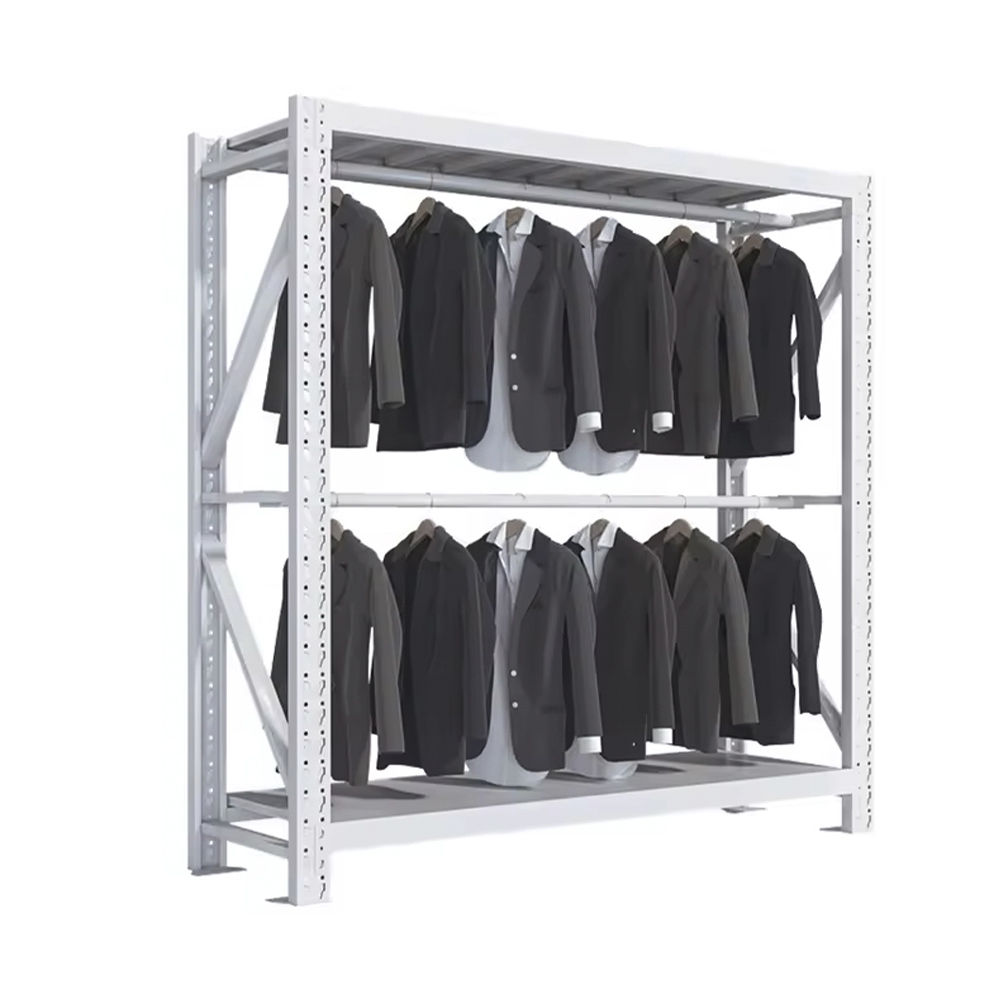
For garages that also function as a mudroom, the vertical hanging requirement changes slightly. Coats, overalls, work jackets and cycling gear need depth and airflow rather than a flat shelf, and a dedicated garment rail keeps them off the floor and out of the way of the parked car.
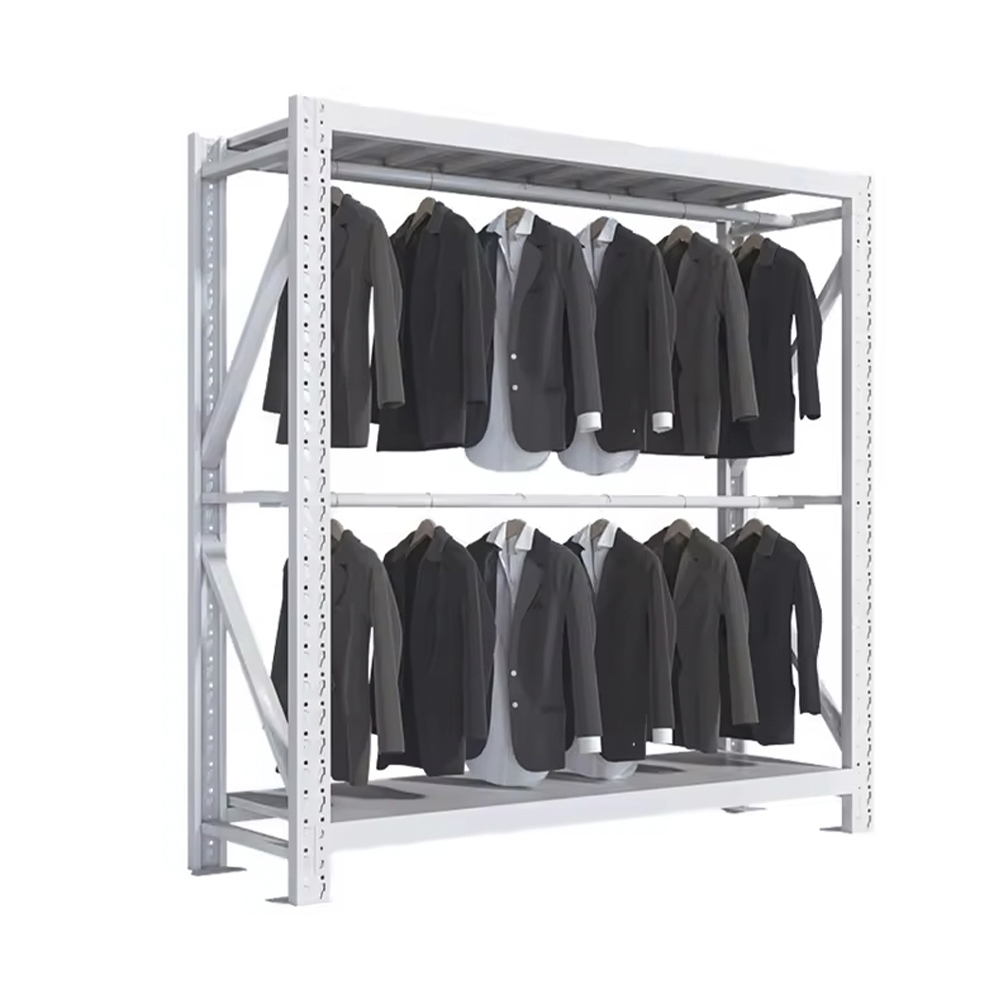 Corrosion Protection Garment Rack for Clothes Storage Hanging Coats ApparelAdjustable hanging rods fit suits, coats and shirts of all sizes. Dual-use design for both hanging clothes and storing folded items.Maximizes vertical space in homes, ...View Product →
The same logic applies when the garage doubles as a workshop. Offcuts, pipe and flat-pack timber store better on a low, adjustable shelf run than on a hook, because they need support along their whole length rather than at a single point.
Plan hanging storage in zones with marked door-swing and car-clearance envelopes, and always pair a hanging rail with a low shelf so heavy bags never end up hooked onto the rail by default.
Anchoring: The Step That Decides Whether It Holds
Every other decision in this guide is reversible. Anchoring is not. Once a hole is drilled into the wrong place, or the wrong fixing is used, the rack is compromised.
Identify the substrate before you buy the fixing
Drill a small test hole in an inconspicuous spot, or use a stud finder that can distinguish between timber, metal and masonry. The four substrates you will meet in a garage behave very differently:
- Solid concrete or dense block takes a mechanical anchor extremely well and is the best-case scenario.
- Hollow block or brick relies on the anchor expanding behind the face, and needs a purpose-made hollow-wall fixing rather than a standard plug.
- Timber studs are strong in shear but only where the fixing lands in the centre of the stud, not at the edge.
- Light gauge metal studs are the weakest option and generally need a bridging plate or a change of mounting plan.
Never trust plasterboard alone
Plasterboard has almost no pull-out strength. A hollow-wall anchor rated for twenty kilograms in a laboratory ceiling is a very different proposition from the same anchor in a garage wall that vibrates every time the door opens. If the wall is board on battens, find the battens or move to a freestanding solution.
Shear versus pull-out
A hanging rail loads its fixings in two directions at once. Gravity pulls down, which the fixing resists as shear. The weight of the item hanging away from the wall also tries to lever the bracket out, which the fixing resists as tension or pull-out. Long brackets hanging heavy loads far from the wall generate more lever force, which is why deep brackets need stronger anchors than shallow ones carrying the same weight.
Torque, spacing and repetition
Anchors are tested to a specified torque. Under-tightening leaves the fixing loose and the rail moving; over-tightening can crack the substrate. Space intermediate brackets no further apart than the rail manufacturer recommends, and remember that a rail supported every six hundred millimetres behaves very differently from one supported only at its ends.
Finally, check the fixings once a year. Vibration, thermal cycling and moisture all loosen connections slowly. A two-minute check with a spanner each autumn is the cheapest maintenance you will ever do.
Identify the substrate first, use anchors rated for both shear and pull-out, and never rely on plasterboard alone to carry a loaded garage hanging rail.
A Sizing Checklist for Buyers and Procurement Teams
Whether you are fitting out a single garage or sourcing storage for a fleet of service vans and workshop units, the same questions decide whether the purchase works out.
- Measure the ceiling height at its lowest point, including any ducting or door tracks.
- Measure the available wall run and subtract the door swing and any window openings.
- List the heaviest single item to be hung, and multiply by two for dynamic loading.
- Confirm the substrate at each fixing position, not just the wall in general.
- Decide the required level spacing so tall items actually fit between shelves.
- Confirm the measured steel thickness of the load-bearing members.
- Confirm the coating type and whether it suits a damp or coastal location.
- Check whether fixings, brackets and end caps are included or sold separately.
For a larger project, such as a workshop, a small warehouse or a set of service vans, the same checklist scales up. The main change is that adjustable systems become far more attractive, because a shelving run that can be re-pitched in five minutes adapts to changing stock without new steel.
An adjustable shelf run also solves a problem that buyers rarely anticipate at the quotation stage: the load profile changes. What starts as a bicycle storage wall becomes a tool store, then a parts store, then a home gym. A shelf system that allows the beam positions to be moved without new components absorbs all of those changes.
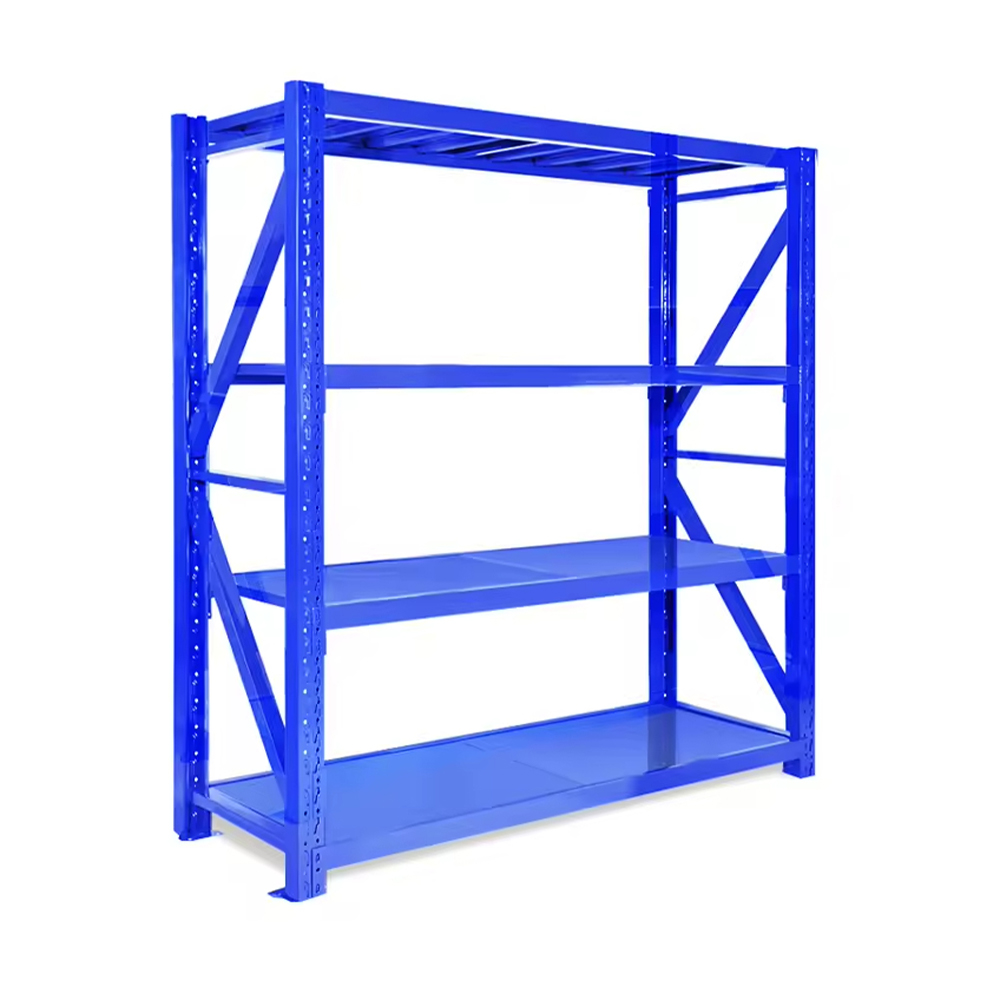
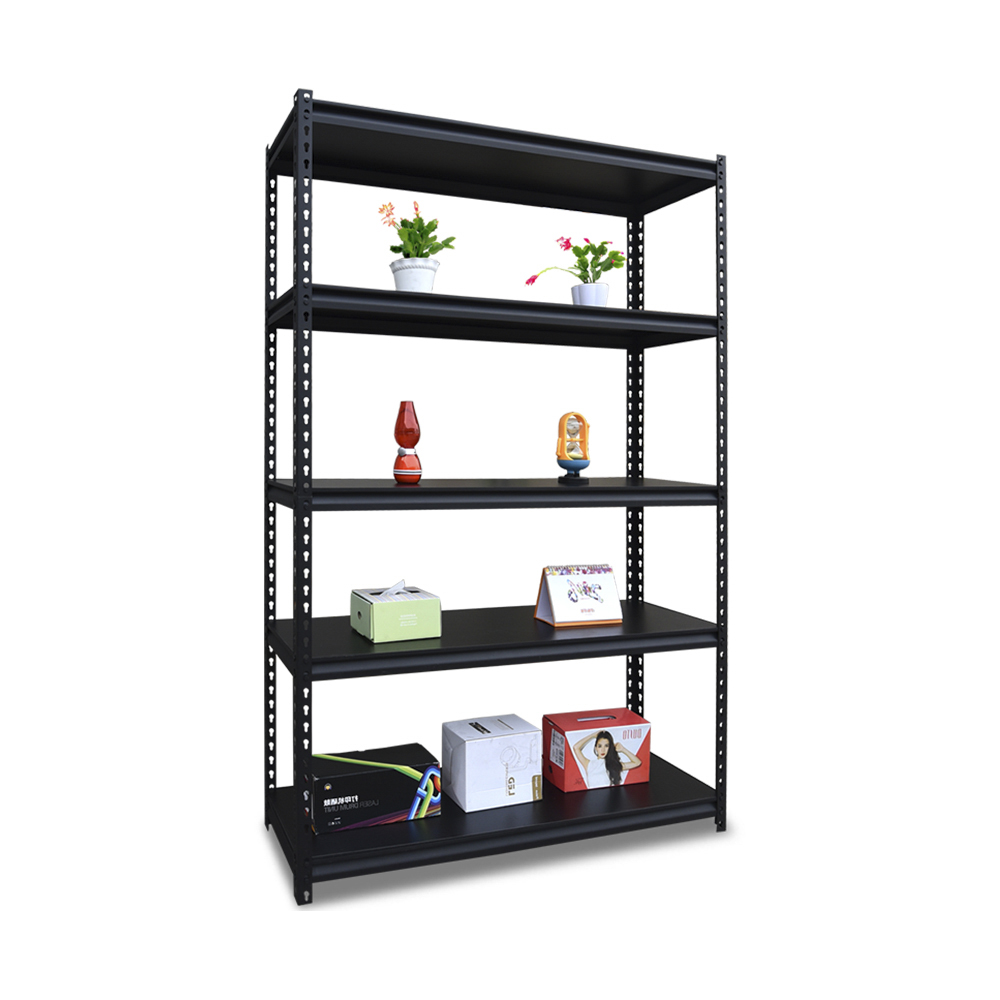 Adjustable Metal Shelving for Home, Office & Warehouse·Durable steel construction with rust-resistant finish. ·5 adjustable tiers for flexible organization. ·Boltless assembly for quick, tool-free setup. ·Open design for ...View Product →
When comparing quotes, ask for the load capacity per level and the number of levels, not just an overall capacity figure. A rack advertised as carrying one thousand kilograms is far less useful if that figure assumes five evenly loaded levels and you only intend to use two.
Specify capacity per level, not per unit, and favour adjustable systems so the storage can be re-pitched as the contents of the garage change over time.
Mistakes That Shorten the Life of a Garage Storage Rack
Most of the failures that show up after two or three years follow a small set of repeatable patterns. Knowing them in advance is cheaper than replacing the rack.
Overloading the middle of a span
The middle of any beam is its weakest point. Hanging the heaviest item in the centre of a long rail, because that is where it is easiest to reach, is the fastest way to produce a permanent sag. Heavy items belong near a bracket.
Loading from the top down
A freestanding shelving unit loaded with heavy items on the upper levels and light items at the bottom becomes top-heavy and can tip. Load heavy at the base and work upward.
Mixing fixing types on one rail
Using a masonry anchor in one hole and a hollow-wall anchor in the next means the rail flexes unevenly, and the weaker fixing takes more than its share of the load. Use consistent fixings that are all appropriate to their own substrate.
Skipping the inspection
Bolts loosen. Coating scratches. Rust starts. None of this is dramatic in month one and all of it matters by year five. An annual walk-round with a torch and a spanner catches nearly everything.
Ignoring moisture sources
A garage that holds a wet car every evening, or that has a tumble dryer venting into it, is effectively a damp room. Coatings that perform well in a dry utility room will not perform the same way here. Where moisture is unavoidable, choose galvanised or stainless components and keep stored items off the floor.
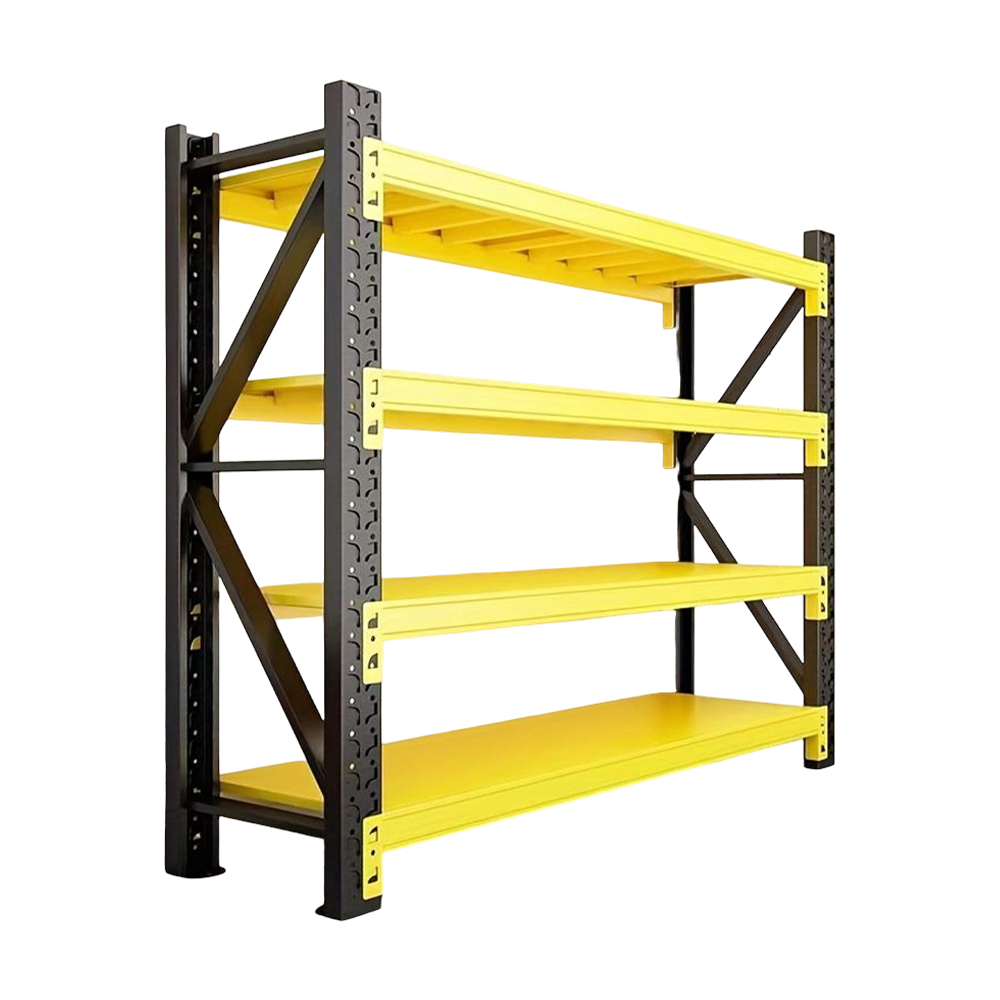
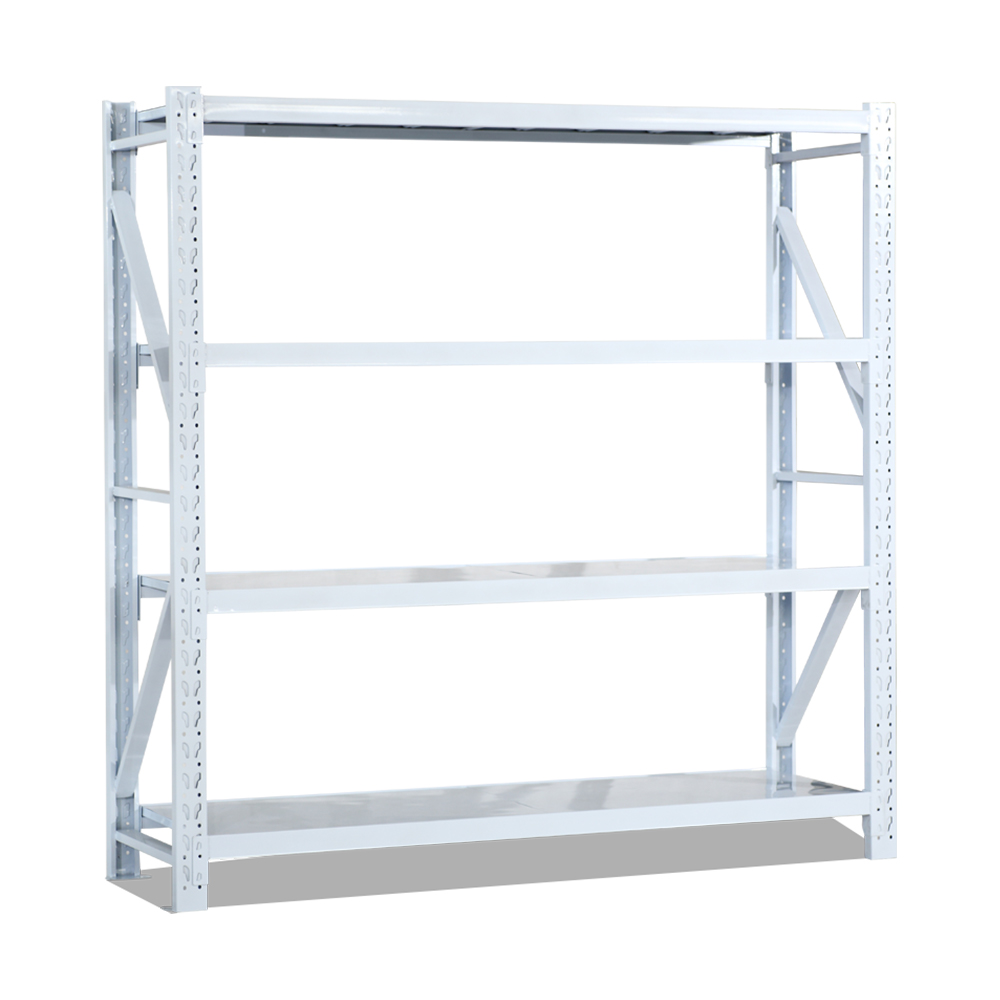 Light-Duty Adjustable Storage Shelving for Home, Office & Retail·Load capacity: Under 200kg per layer ·Butterfly hole uprights for tool-free installation ·Height-adjustable shelves ·Anti-rust coating: acid pickling + powder coating...View Product →
Light-duty adjustable shelving is genuinely useful in a garage when it is used for what it is rated for: paint tins, hand tools, boxes of fixings, garden chemicals. It becomes a problem the moment it is treated as a heavy-duty rack for engine parts or tyres.
Concentrate heavy items near brackets, load units from the bottom up, keep fixings consistent along a rail, and inspect everything once a year.
What to Ask a Manufacturer, Supplier or Wholesaler
If you are sourcing hanging and shelving storage in volume, for a chain of workshops, a property portfolio, a retail chain or a distribution operation, the conversation shifts from product features to production capability.
Questions that separate a factory from a trading desk
- What is the measured steel thickness of the load-bearing members, and how is it verified?
- What surface treatment is used, and how does it perform in a damp or coastal environment?
- Are fixings and brackets included, and are they rated for the stated load?
- Can levels, widths and depths be adjusted to a specified drawing?
- Is OEM or ODM work supported, including branded packaging and documentation?
- What is the packing method, and how is damage in transit controlled?
- What are the lead times for a repeat order, not just for the first one?
Why factory scale matters to a garage buyer
It is easy to assume that manufacturing scale is only relevant to large industrial buyers. It is not. A producer with a substantial factory floor area and an integrated operation covering product development, manufacturing and quality control can hold tolerances consistently across repeat orders, which is exactly what a multi-site rollout needs. A trading company reselling whatever is available that month cannot.
It also matters for custom work. Garages are not standardised. Ceiling heights, wall runs, door positions and vehicle footprints vary from site to site, and a storage plan that ignores this ends up with rails in the wrong place. Working directly with a manufacturer means dimensions, bracket positions and finish specifications can be adjusted before production rather than after delivery.
For buyers comparing manufacturers, suppliers and wholesalers, the useful filter is simple: ask for a drawing, a load calculation and a sample fixing detail. A producer will supply all three. A reseller will usually supply a catalogue.
If you would like to discuss a specific garage, workshop or multi-site requirement, you are welcome to talk to our team about dimensions, finishes and volume.
Ask for a drawing, a load calculation and a fixing detail: a manufacturer can provide all three, and those three documents prevent almost every installation problem.
Frequently Asked Questions About Garage Hanging Racks
How much weight can a hanging rack in a garage safely hold?
It depends on three things: the substrate, the span between fixings and the thickness of the steel. A light-duty shelving unit may be rated at fifty to one hundred kilograms per level, while a medium-duty steel rack typically handles one hundred and fifty to three hundred kilograms per level. The published figure always assumes even distribution and a correctly anchored installation, so treat it as a ceiling rather than a target.
Can I mount a hanging rack directly onto plasterboard?
Not for anything carrying meaningful weight. Plasterboard has very little pull-out resistance, and a garage wall vibrates every time the door moves. Locate the studs, battens or masonry behind the board and fix into that instead. If there is nothing structural behind the board, use a freestanding storage unit.
What is the maximum span I should leave between brackets?
Follow the rail manufacturer's stated spacing, and shorten it rather than extend it if you are hanging heavy or frequently used items. As a rule of thumb, deflection increases sharply with span, so adding one more intermediate bracket is usually more effective than buying a thicker rail.
Is powder coating good enough for a garage?
Powder coating performs well on dry internal walls. It is a barrier coating, so any scratch that reaches bare steel becomes a rust starting point. In garages near the coast, or those with a wet car parked inside every night, galvanised or stainless components hold up considerably better.
Should I choose wall-mounted or ceiling-mounted hanging storage?
Wall-mounted rails keep the floor clear and put items at a comfortable working height, but they depend entirely on the wall. Ceiling-mounted systems use overhead volume and leave walls free for shelving, but need joist access and adequate clearance above the vehicle. Many garages use both.
How often should a garage rack be inspected?
Once a year is a reasonable minimum. Check that fixings are still tight, look for scratches that have exposed bare steel, and confirm that nothing heavier than intended has migrated onto the rack. A two-minute check with a torch and a spanner prevents most long-term problems.
Can hanging storage be used for coats and workwear as well as tools?
Yes, and it is often the best use of the wall nearest the internal door. A dedicated garment rail handles depth and airflow better than a flat shelf, and it keeps wet jackets away from the parked car. The key is to keep the rail rated for the load and free of items that belong on a shelf.
What should I check before ordering storage for multiple sites?
Measure each site individually rather than assuming a standard layout. Ceiling heights, wall construction, door swings and vehicle footprints all vary. A supplier that asks for those measurements before quoting is a supplier that has done this before.
Substrate, span and steel thickness answer nearly every garage hanging rack question, and all three should be confirmed before any hole is drilled.
A garage hanging rack is a simple piece of equipment doing a demanding job in an unforgiving room. The steel is rarely the weak link. The wall behind it, the distance between the fixings and the honest weight of what gets hung there decide everything.
Measure the substrate before ordering. Keep spans short and brackets frequent. Choose a coating that matches how damp the garage actually gets. Load heavy items low and near a support. Do those four things and the rack will still be doing its job long after the bicycle it holds has been replaced.



 English
 Español
 русский
 Français
 한국어
 عربى
 ไทย
 Deutsch
 Bahasa Melayu
 Português
 Polskie